Tagged with " protest"

On Being Far Away, pt. 1

Activism is in my blood. I’m not sure how it got there—it certainly isn’t genetic. My family has always been more about service, which is good and fine and I’m about it too. I grew up around my grandma and my mom holding church rummage sales, teaching Red Cross swimming and first aid classes, and leading Girl Scout troops. I learned a lot from that, and I gained a healthy appreciation for the warm glow you get from helping others. But that was never enough for me.

I’ve always been driven to take action when I see something wrong. Every time someone asks me when I started causing trouble (good trouble, as John Lewis called it, I’d like to think), I think of something earlier: “Well, in high school I organized…oh wait, when I was in junior high I went to the city council about…wait, does that thing I did in grade school count?” I’ve since discovered that the activist in me may actually just be the autism in me–neurodivergent people are often characterized by a strong sense of justice and empathy that compels them to challenge unfair systems that harm others. Just think of Greta Thunberg, who often speaks about the connection between her autism and her activism.

I’m no Greta, but I’m proud of my place on the front line of movements that matter to me. Whether it was in the halls of power or the streets, I like to put my body and my voice where showing up matters. And I’ve found the very best people I’ve ever known in those places. That’s not surprising—it’s easy to find friends when it’s a self-selecting group who share your values and passions. And if things get risky, as they sometimes do if you’re challenging authority, there’s probably a fair bit of traumabonding to seal those friendships.

Leaving friends behind was easily the hardest thing about moving to the other side of the world. (Well, leaving so many books behind was hard too, but at least we could pack up some of those and take them along.) I also really struggled with the feeling that I was abandoning my post before the fight was won. I worried that people I respected and cared about would feel that I was quitting the work, that I wasn’t as committed as I said I was. 
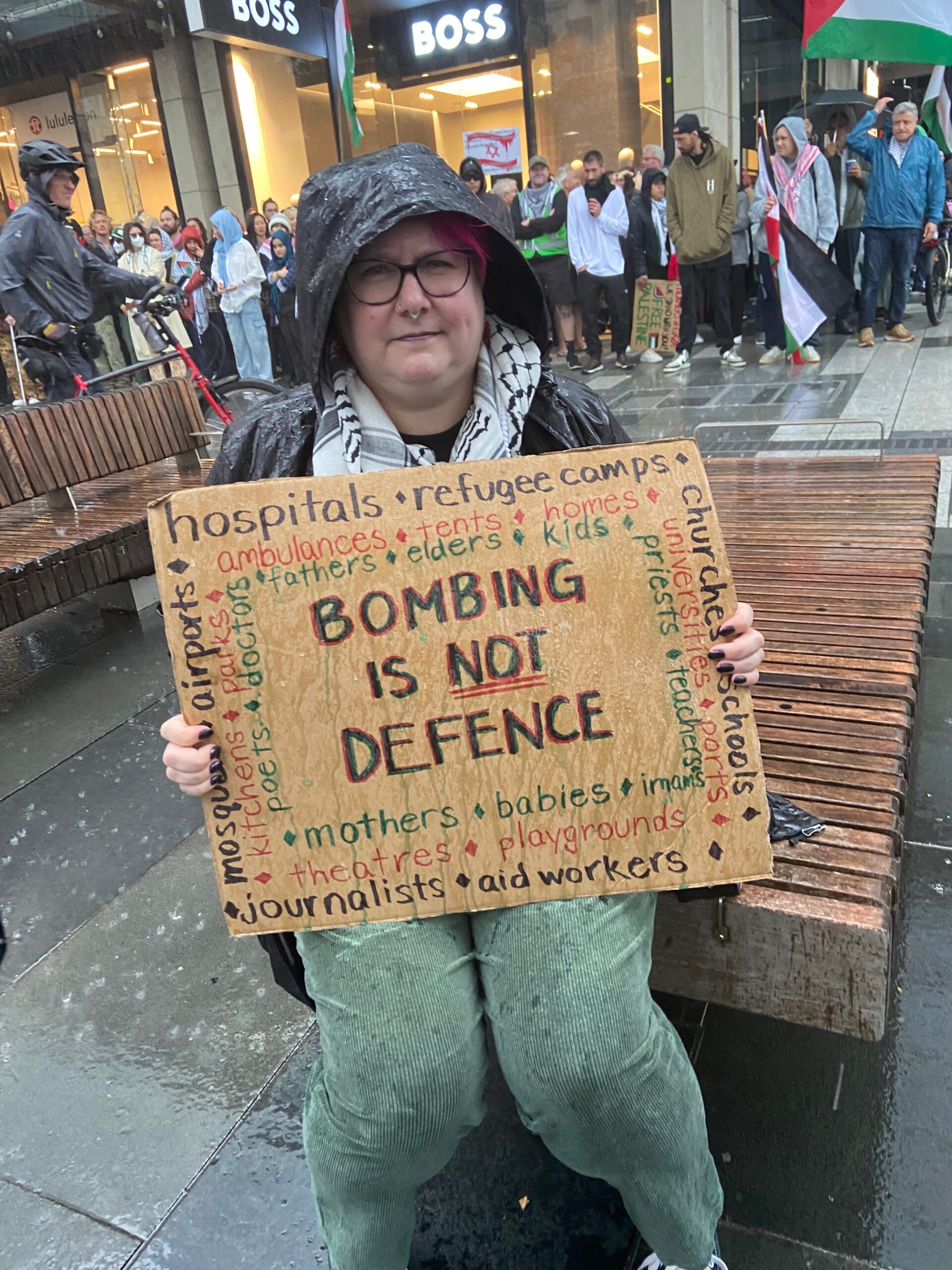
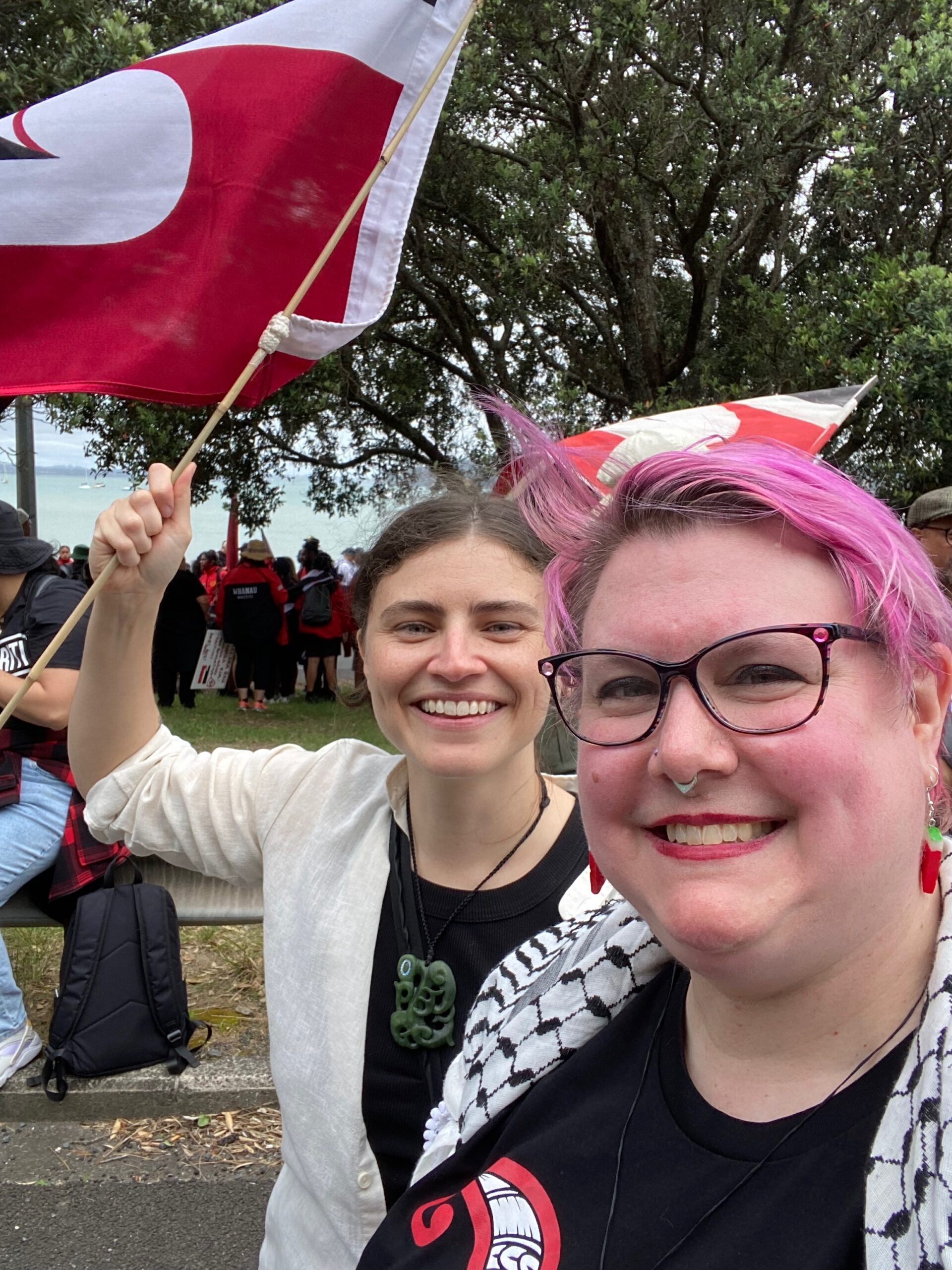
A fat middle aged white woman with glasses and a raincoat with the hood up sits in the pouring rain. She wears a Palestinian keffiyeh scarf around her neck, and she holds a soggy cardboard protest sign.I’ve continued my activism in new ways down here. Two white women, a young one with brown hair and a fat middle aged one with short pink hair and glasses, are smiling. The young woman holds a Maori tino rangatiritanga flag.But my heart is still divided. If you asked me where “home” is, I’d still have to say America. Watching those friends I love—and so, so many others—fight for the soul of that home is wrenchingly hard. And one of the hardest parts of that is that I’m not there, shoulder to shoulder with them.
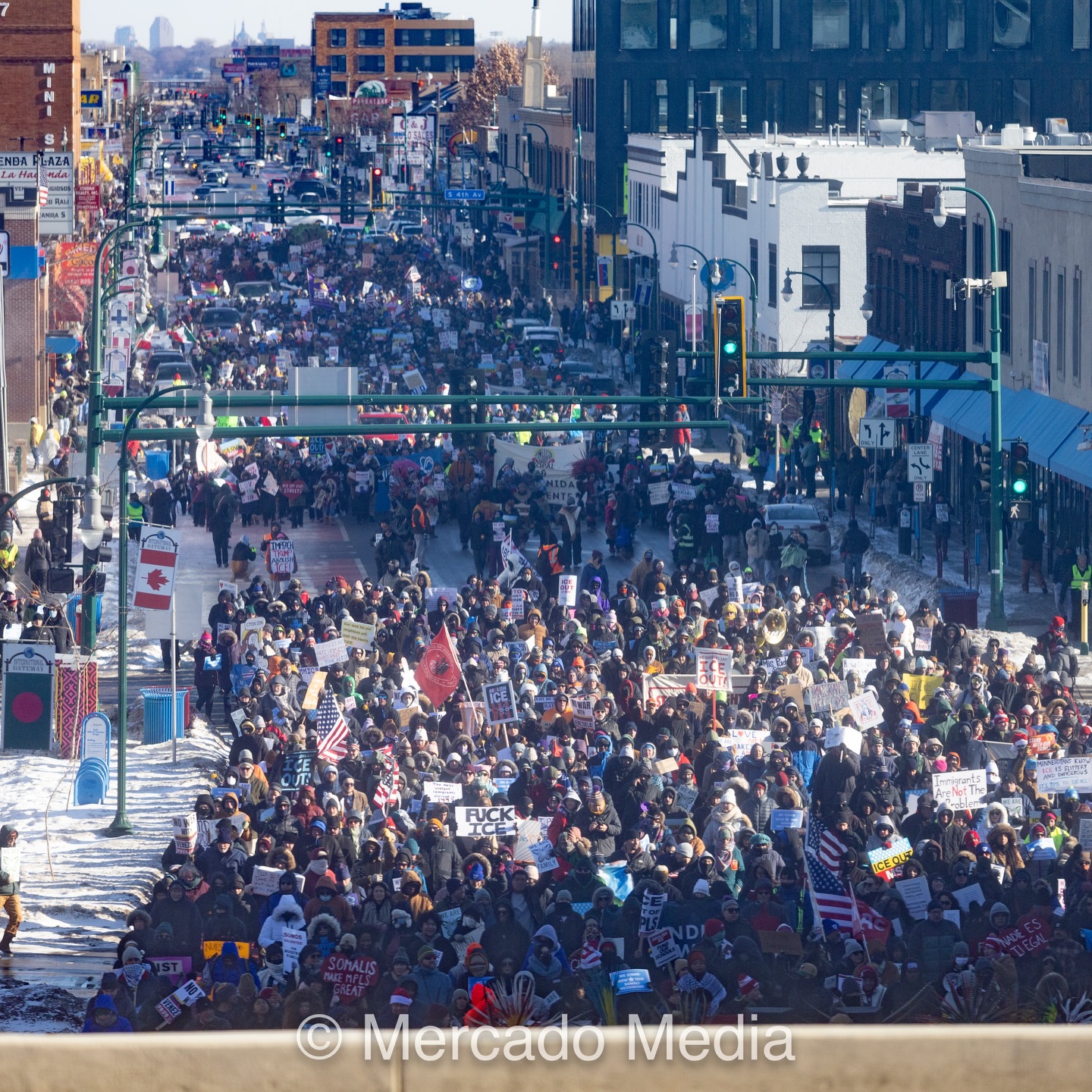
This has intensified to a painful extent over the last two weeks as ICE invades my home, kidnapping and terrorizing people around Saint Paul and Minneapolis. I know the suburbs and street names in the news reports. I remember the sights and sounds and smells of places like Mercado Central and Karmel Mall. I belong in the pictures of 10,000 people marching down a frosty Lake Street and linking arms in front of the Whipple Federal Building. I want a whistle to warn my neighbors. I feel chants and songs trapped in my throat. I need to be there. I need to fight.A long aerial shot of 10,000+ people marching down a wintry Lake Street in Minneapolis.
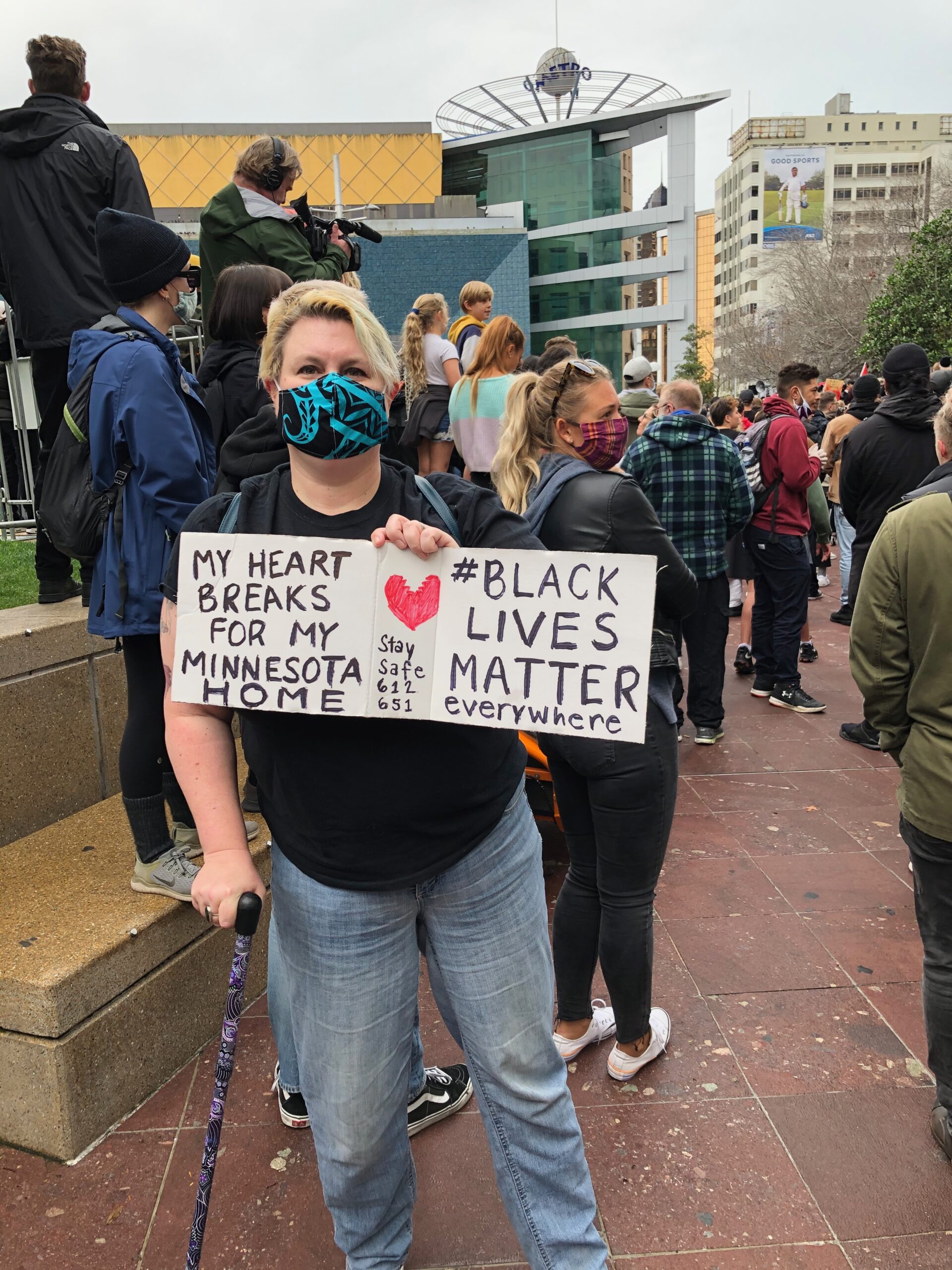
Watching the world from down here has often inspired what feels a lot like survivor’s guilt. For months at the height of the pandemic, we were free of masks and fear—easy enough for a remote island nation of only 5 million people. Even when the disease was running rampant, we weren’t traumatized by numbers of deaths in the tens of thousands, then hundreds of thousands, then over a million. And in the midst of that horror, I witnessed the enraging tragedy of George Floyd’s murder on a street I’d driven hundreds of times. The need to be there, to stand with my community and my activist comrades, kept me up at night like it does now. I went to the solidarity protest here in Auckland because abusive, unaccountable police culture is a global rot. But I didn’t help to shut down a highway or marshal a march, and I felt that inaction in my bones. It was a wrong feeling I couldn’t right.A masked-up fat white woman with short blonde hair, glasses, and a cane stands in a crowd. She holds a sign that says "My heart breaks for my Minnesota home. #BlackLivesMatter everywhere. Stay safe 651 612"
In a choir, you keep singing to cover others when they need to breathe, just as they keep singing when you breathe. Activism works the same way: others show up when you can’t. There’s no gap when someone leaves—the line is never really broken. That’s been a comfort, but it’s also been an ache. I’m glad there’s no hole where I used to stand, because that would leave the people I care about exposed. But I can’t step up to give them a rest when they need one, no matter how much I want to. Saying “I’m with you in spirit” isn’t too different from offering thoughts and prayers. That’s never going to feel like enough, no matter how much of my heart is behind it. 

I need to learn to treat myself like I treat others who have to step back because of circumstance or self-care: with the grace of unconditional forgiveness and appreciation from what they can do with what they have, from where they are at that moment. Here is where I am, and I need to have faith that I’m doing good work and so are they. We’re fighting the same unjust systems on different fronts. And when we win, we’ll meet in the middle and embrace.
Dec 15, 2014 - Physical Ed    No Comments

No One Left Behind

A lot of the social justice work I do is about making spaces–everything from housing to the whole of Minnesota–more welcoming to people whom society often forces out. Sometimes, that’s practical stuff, like urging schools or cities or events to offer gender-neutral bathrooms where trans*/gender non-conforming folks can feel safe. And sometimes, it’s more abstract, like working against police profiling and brutality toward people of color in their own homes and neighborhoods.

The basis of that work is education and empathy. I read, I listen, I ask questions, so when I walk into a new space, I see the ways that place values and welcomes all different kinds of people and their needs. And I also see the ways those spaces exclude and isolate people, which makes a good starting place for effecting change.

So I’ve attended community meetings, planning sessions, trainings, and seminars. I regularly participate in protests, which might include rallies, marches, and sit-, stand-, or die-ins. And the saying in the groups where I organize is that, “If it’s worth doing, it’s worth debriefing,” so I’m learning how to observe what does and doesn’t work well, and share constructive feedback.

But it’s possible for a space that’s been engineered with great intention to include a typically excluded group to unintentionally exclude a different group. Some feminists say they don’t feel safe from patriarchy and misogyny if trans* women are included in the space (I happen to think they’re wrong, for the record). Often, queer people of color feel uncomfortable in the largely white LGBTQ activist movement. Class barriers manifest often in community meetings, where those with more income and education assert themselves as more worth listening to than their less privileged neighbors. We all need to do better, even if we think we’re doing the right thing just by showing up.

As I see intersectionality championed in the powerful, new spaces we’re constructing, though, we’re missing the mark on disability. I’m physically and neurologically disabled, thanks to the Wonder Twins, fibromyalgia and autism. I’m not the most restricted person at a gathering, but I do face barriers that others don’t. I’m also used to being in the company of someone with more intense disabilities, though, so I’m attuned to obstacles so I can help them negotiate our environment.

And the new movements need to do more. I’ve had to choose which breakout session to attend based on which didn’t require me to climb a flight of stairs. I’ve had to leave valuable trainings early because the bright lights and unchecked noise level wore me out. I’ve also sat through meetings which taught me nothing because I couldn’t hear or see the speakers. And I’ve both hurt myself trying to keep up, or just fallen out completely, with marches that followed a route and went at a pace that left all but the able-bodied behind.

And I’m full-sighted. I’m not in a chair. My lungs and heart are strong. I have 40 years of coping skills to manage sensory input. I hear exceptionally well. If I can’t keep up, who else is bejng left behind? And what knowledge and wisdom are we losing when they’re abandoned?

I have a lot of thoughts about accommodations and modifications to make the spaces where real, radical, revolutionary change is happening accessible to all disabled people. I’ll probably break them into separate posts.

But I’m asking each of you who reads this to spend a bit of time thinking and examining your surroundings with renewed curiosity. Think of the physical gestures that literally embody the movement: raised fist, raised hands, bodies marching and lying down. Imagine that you can’t make those gestures in solidarity. Think of the speaker whose voice and insights you most want to hear in the world. Imagine the flight of stairs that keeps you from getting to see them. Imagine seeing that person but not knowing what they’re saying.

How welcome would you feel? How valued? How powerful?

If the answer is “not very,” well, the revolution’s got to change.

Mar 25, 2014 - Physical Ed    No Comments

This Dissenting Body

Every body I inhabit is a dissenting body.

Anxiety, anger, and disorientation emanate from my autistic sensory body. I can’t stop listening to other people’s noise through the walls, and each heavy footfall above me bruises my eardrums. A puff of my husband’s breath on my face is enough to wake me from a sound sleep. I adjust the blinds, the lights, the brightness of my screen in constant rotation. I seek refuge under the comforting weight of white noise and thick blankets, even when my heart longs for other people and open air.

My physical body protests in a language of chronic pain and sleeplessness. These disruptions occur arbitrarily; actions which give me joy now may trigger furious flares an hour, a day, a week later. And if physical penalties for disobeying my body’s limitations weren’t enough, it also inflicts its dissent on my psychological self by failing to administer the correct neurological chemicals to avoid the fogged-in abyss of depression. Sadness begets sleeplessness begets pain begets sadness, and so forth.

I often find my body unacceptable, and so does society. Every narrow seat, every cutting waistband, every judgmental voice tells me I don’t fit expectations. I brush, I tweeze, I shave, I wax, I drape, I shift, I cut, I hide. My shape is segregated into shrinking fabrics and diminishing retail spaces. It is targeted with advertisements and poisons. On the days when my body prevents me from doing meaningful work or feeling lovable, I am crushed under relentless waves of warfare.

And even if my body could fit into the definitions of worth, its very identity—as a woman, as a bisexual, as a disabled person—is constantly erased for others’ convenience. The conditions of my existence are subject to legitimized dismissal by the medical establishment, the justice system, the corporate structure that wants to suppress and exterminate that which cannot turn a profit. Reproductive control and healthcare are privileges I can check out with my skin color, only to be recalled by my economic status. If I wear my gender too openly, I’m asking for sexual assault. If I conceal my gender too well, I risk violent words and acts by those threatened by challenges to an artificial binary.

So because all my bodies are cause for dissent, I use my body as an instrument of dissent. I’m learning to seek pleasure, and to wear my rolls and creases, flagrantly and without apology. I’m walking into the halls of power to demand care for my body and others like it, through access to healthcare, economic security, an end to rape culture, and equal rights for LGBT and disabled people. I’m raising my voice in rhetorical flourishes and strident shouts to demand an end to systems of racist, sexist, and classist oppression, fueled by corporate and military powers seeking to buy or win what I am entitled to as a citizen and human being.

As long as I have a dissenting body to my name, I will use it to obstruct that which oppresses it.

Mar 20, 2014 - World Religions    No Comments

Quid Pro Quo

I went to college with Fred Phelps.

I went to the University of Kansas for school, and he went there with his congregation to protest the Big Gay Agenda. He held signs promising us a swift trip to Hell in front of the liberal arts building where my first out gay friend and I boywatched together on the broad, sunny plaza known as Wescoe “Beach”. He protested outside the Kansas Union where I got gouged on textbooks—believe me, I wished to protest those days too.

And to my everlasting mystery, he picketed and shouted outside every single one of my college choir concerts. Monteverdi’s Vespers. Tallis’ soaring, complex 40-part motet. Mendelssohn’s Elijah. Franz Biebl’s achingly beautiful “Ave Maria”, sung at every Christmas concert. The greatest music ever composed—most of it commissioned and performed for the greater glory of God—earned his scorn without fail. Not that he ever heard a note of it.

Obviously, this defies logic, as did his entire mission in life. Logic has little to do with fear and hate. To Phelps and the Westboro Baptist Church, all that mattered was the existence of LGBT people living happy, honest lives on and around the KU campus. Do liberal arts and the fine arts department have a particularly higher number of them? Who knows.

In any case, a kind tradition developed among the upper- and underclassmen at KU. The first time freshmen encountered the WBC was usually on Jayhawk Boulevard. The placards they held proudly weren’t the only statements they made; they said hateful, hurtful things to anyone who walked by. Many freshmen felt compelled to stop and try to reason with them, to ask them to reconsider their beliefs—especially if they had children with them (which they usually did). Reason turned to frustration as the students met their implacable, mile-high wall of bigotry and conviction.

Just as fury began to ignite, some upperclassman would approach and put a gentle arm around the freshman’s shoulders. “Come with me,” they’d say quietly as they guided them away. Out of earshot, the older student would say something compassionate and honest about futility and self-care, irrationality and good intentions. With a pat on the shoulder, they’d go their separate ways: one gratified at having done a good deed, the other sadder but wiser for the experience.

In a year or two, they’d be the older students, guiding another generation of freshmen away from Phelps.

I don’t hate Fred Phelps—he hated enough for a million people’s million lifetimes. I don’t believe he’s in Hell, because I don’t believe in Hell. But if God is Love in the Christian Gospel, he spent his whole life away from God, which is the very definition of Hell in many religions. And he died in a world that more lovingly and openly welcomes the whole selves of LGBT people than it did when he began his work, so he must have known that his mission was an abject failure. He was even abjured by his own flock on his deathbed, after watching many of his own children and grandchildren defect from his church (and even Christianity, in a few cases) over the years. When you pursue scorched earth policies, all you have left at the end is a whole lot of scorched earth.

I know the immeasurable psychological and spiritual harm his hate has caused people over the years, but I don’t rejoice in his death. I don’t want to dance on his grave. I think he would take it as a sign of his righteousness if hundreds of people picketed his funeral with profanity and disrespect. The silence of business-as-usual in Topeka that day would be the most effective punishment of all.

But he wished my friends and me dead at every one of my choir concerts. And I find I have the urge to sing towering works of glory and beauty where he lies dead.

Aug 1, 2012 - Political Science    2 Comments

Politics Most Fowl

I’m going to come right out and say this:

I don’t like Chick-Fil-A.

I mean, I really don’t like their sandwiches. I’m pretty sure no one but me cares, and that’s fine.

No, I’m not just piling on the little guy (if a corporation can be a “little guy;” Citizens United be damned), and I would die for the company’s president to say whatever damnfool, hateful nonsense he wants. This is America, and both religion and speech are still free, even inhumane and cruel religion and stupid, self-serving speech. I just think their chicken tastes like crap.

But in the noise and the furor over the statements and counter-statements, the protests and counter-protests, I only have a few things to add, all of which are unsophisticated and not worth arguing over.

1)  Boycotts work. If you don’t agree with a company’s politics or actions, don’t give them another dime. Yes, the first place they feel it is in local franchisees, and that’s maybe not whom you want to hurt when you drive on past. But corporate offices sure as hell notice boycotts, and they are incredibly powerful tools of protest.

2) Be kind to the people who work for the corporation you’re targeting with your protest. I’d be willing to guess that there are a lot of people who work for Chick-Fil-A who work there because it’s a job. They’re mainly college kids trying to scrape up tuition money for next semester, senior citizens whose Social Security wouldn’t keep them in food AND meds, and a whole bunch of underemployed people who just need a steady income as they come out the other end of the financial disaster we’ve just weathered.

They’re not anti-gay; they don’t value anyone less than another. (Though there is this, which is a little weird.) They’re scared as hell that someone’s going to belly up to their counter today and release a spew of bile and invective at them, and hold them accountable for something beyond their ken. And that spew goes both ways. Imagine the pain of having to suffer through some bigot’s tirade about gays going to hell, followed immediately by an irate liberal’s rant about how they’re a horrible human being for taking a paycheck from a company that crushes the dreams of little gay boys and girls.

I get queasy just thinking about that level of confrontation, all day every day.

So, if you want to make a big scene, for god’s sake, don’t drop a glitterbomb on the counter at a Chick-Fil-A. Some kid with developmental disabilities, on loan from the local group home, is going to have to sweep up every single flake before he can claim his discounted, hours-old, half-cold, slowly-lethal chicken lunch in the janitorial closet. That’s the way fast food works, and you’re not punishing the right person.

Just got to make a point? Grab your best friend, ask to see the manager, kiss that friend right on the mouth, and tell them that you love everyone. And then go home and cook dinner for your family.

Correction: Don’t just kiss your friend–hug the manager. Tell him/her how sorry you are that the company owner put their business in this position. Then donate the cost of your meal to one of the marriage equality fights in the country right now (in Washington, Maryland, and Minnesota). And THEN cook dinner for your loved ones.

Lace ‘Em Up

When I hear about a rally or a march or campaign that stands for something I believe in strongly, I say, “Uh-oh. Time to lace up my Protesting Boots.” This is not an idle statement, nor a clever euphemism.

These are my protesting boots. I bought them at Shelly’s of London. They’re actually Tank Girl boots. There aren’t laces in them at the moment because they were needed for a science experiment, but note the speed-lace loops.

They’re not pretty boots–I didn’t buy them to be pretty. They’re scuffed, and the little metal teeth on the toes are rusty. But they’re padded, and comfy, and heavy, and just right for kicking ass. I love my Protesting Boots.

I’m not really sure where my mile-wide activist streak came from. I come from a family of selfless volunteers and helpers, determined to contribute to any and all communities of which they’re a part. My grandma taught Red Cross first aid and gave swimming lessons to disabled children, when she wasn’t running inner-city Girl Scout troops. My mom was PTO president and ran the Sunday School program at the church I grew up in. Now, she’s a dedicated member of the 501st Legion (TR7084, Florida Garrison, Makaze Squad), and despite two artificial hip joints, she troops at every fundraising march to which they’re invited. (My stepdad and brother are also members.) Most of their commitments come from genuine Christian charity and human compassion, the spirit of which I’m immensely grateful to have had modeled throughout my formative years.

But none of my immediate family is particularly activist, or politically inclined. The first real activism I engaged in was a fight against the school board, to keep them from moving our beloved band director from high school to elementary after he returned from his sabbatical (during which he worked toward his Ph.D. in trombone performance). We got our parents all worked up, and we packed the meeting room the night they were supposed to consider teacher placement. But just before they started in on the topic, they announced that they’d reconsidered, and Don would be returning to the high school the next year. We were relieved and excited, but humming with the unspent fight we’d girded for.

My first real experience protesting was against the First Gulf War. In fact, I ran all the way home from the college protest meeting to tell my parents to turn on CNN because they’d started bombing Baghdad. I was one of a small group of students at my school who got in trouble for refusing to participate in the Pledge of Allegiance, if only because we couldn’t see how we were being disrespectful to a flag that they thought was fine to sew onto all the disgusting, sweaty athletic uniforms, or to fly over battlefields where we had no business being.

Later, the school tried to crack down on boys wearing of cutoff t-shirt sleeves as headbands. (It’s a skater thing. It’s probably on Wikipedia, or in the Smithsonian, by now.) Targeted at friends who were routinely threatened, even beaten, by jocks who called them every homophobic slur you can think of, I naturally took exception. A bunch of us invoked Title IX, took it to the administration, and organized as many girls as we could into wearing them too. Such a silly small fight, but as I look back now, I see the pattern developing. My stepdad actually understood this piece of me better than anyone else; he’d flirted with Quakerism, and was at the March on Washington for civil rights to hear Martin Luther King, Jr.’s dream.

In my adult life, I’ve volunteered for numerous causes, if only because I have more time than treasure to support the campaigns I believe in. I gravitate toward issues of human rights, free speech, justice, and democratic (little d) freedoms. I canvassed so much in 2008, with 2-year-old Griffin in his stroller, that every time I reached for my purple clipboard with all the campaign materials and lists on it, Griff would groan, “NOOOOO OBAMA!”

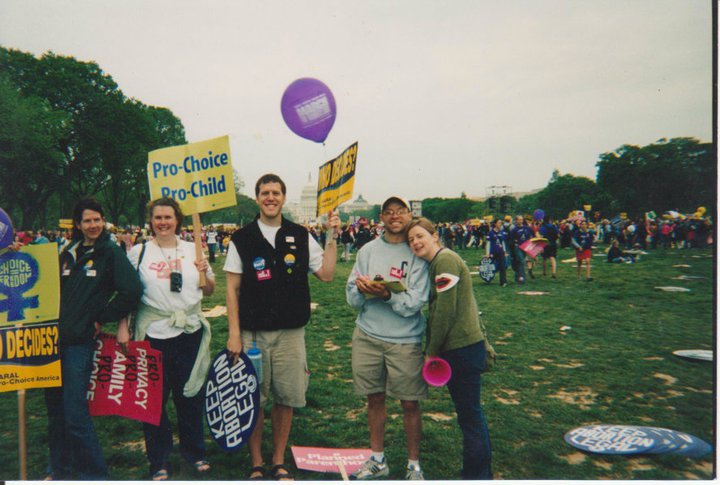
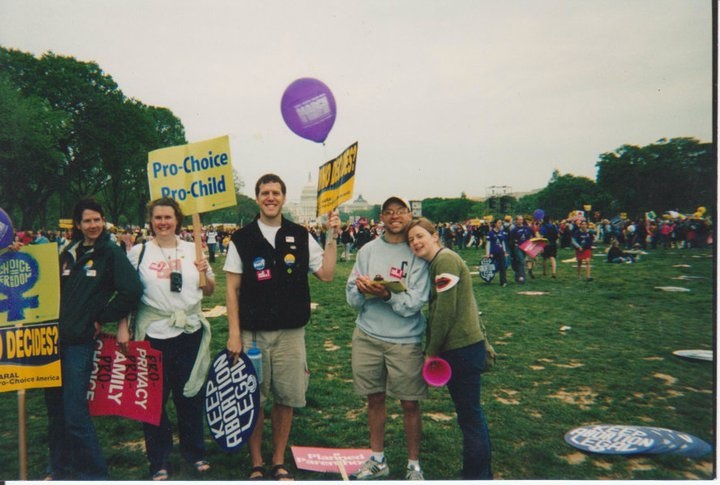
But the single greatest protest experience of my life was the 2006 March for Women in Washington, D.C. I went with a group of friends from grad school, and it was the very first night I’d spent away from Connor, who was nearly two. I have only the vaguest memory of Tina Fey and Amy Poehler and Cybill Shepherd, speaking on the National Mall, but what’s indelibly etched into my most 3D, high definition, full-sensory memory is walking down the dotted line in the middle of Pennsylvania Avenue, holding high a sign that said, “Pro-Choice, Pro-Child.” Because I was, and am, and in that electrifying moment, I was more sure of my own power and identity than I’ve ever been, before or since. I owned that street. I could change policy, I could influence outcomes, I could stand for the silent. I was mighty.

And once you’ve had that drug, once you’ve danced at the victory party, once you’ve cried as election results rolled in, you just can’t get enough of it. Currently, I’m working as a team leader in Saint Paul for Minnesotans United For All Families, the organization fighting the proposed amendment to the state constitution banning same-sex marriages. It’s going to be a lot of work between now and November, on top of the other political work I’ll no doubt take on, but I can’t imagine writing injustice into the permanent guiding principles of any state or country.

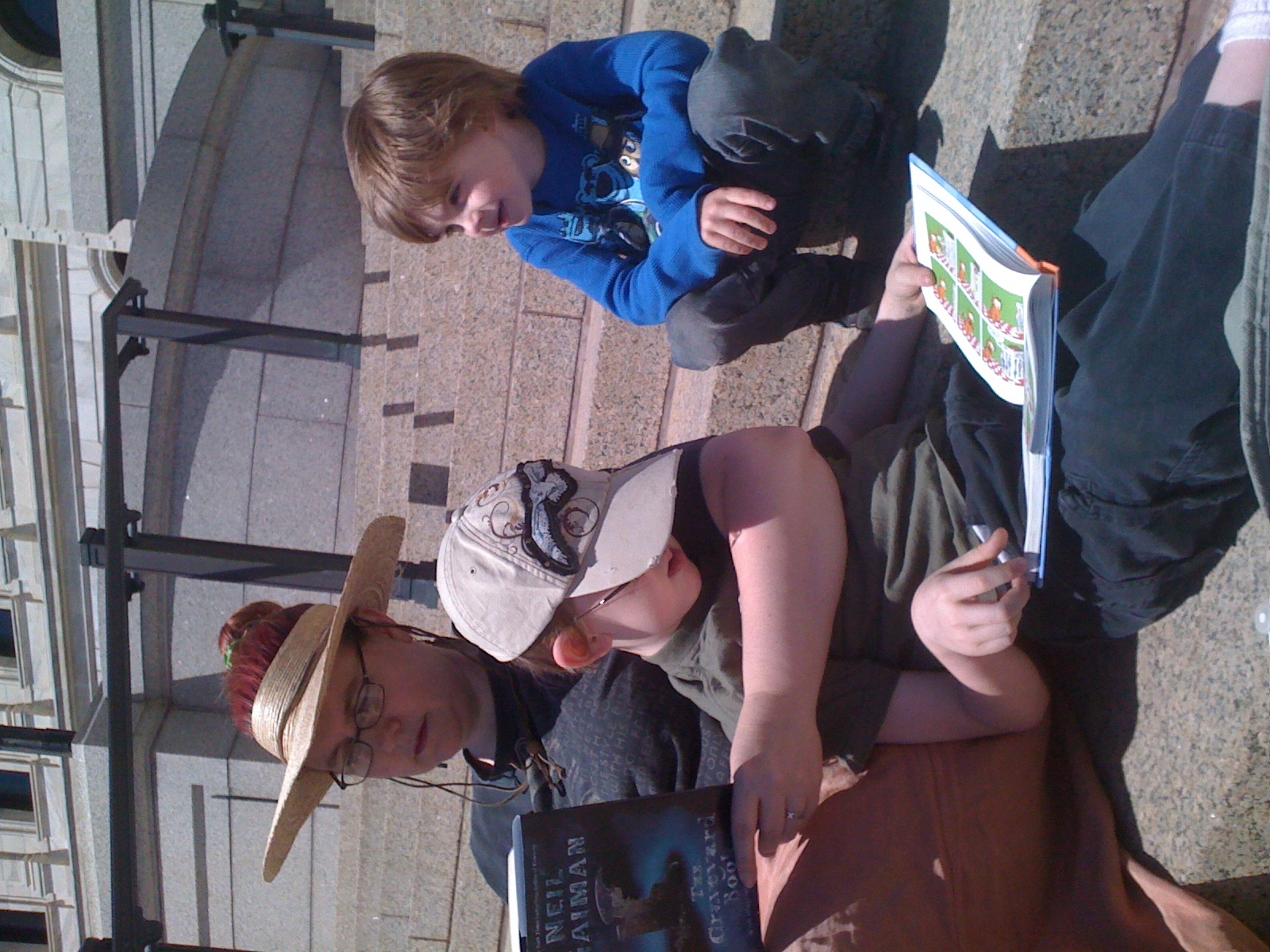
I wrestle with being the parent and the activist. My heart aches for the tiny children I see holding horrid, hateful signs they couldn’t possibly understand at funerals and Planned Parenthood locations. Sure, I gave my 2 1/2 year old a sign that read “Bush Is Scary, Vote For Kerry” at a rally in 2004. And when a MN state legislator slammed Neil Gaiman for “accepting” a 5-figure honorarium from a community library for doing a book talk and signing (“accepting” is in quotes because he turned right back around and donated it to a library support organization, as he often does), I didn’t give my family any choice about whether we’d go to the Read-In for Civility on the capitol steps. But I want them to grow up with their own priorities, their own causes, their own voices.

I want my kids to grow up thinking it’s worth the effort to stand up, be heard, and work for values they believe in. I want them to grow up knowing that it isn’t acceptable for one group to oppress another, or to silence a voice just because it disagrees with someone powerful. I want them to open their hearts, to make themselves vulnerable, by caring about the fate of humanity and the planet. If their values don’t always match mine, I’ll talk to them to find out where they’re coming from and make sure they’ve got all the information to make an educated stand, but I won’t make them back down. They have the same rights I fight to ensure for others.

And some day–maybe soon–I’ll take them shopping for their very own Protesting Boots.


Jan 18, 2012 - AV Club, Political Science    1 Comment

One For The Road

Websites all over the Internet are blacked out today, in protest against the proposed anti-piracy legislation making its way through the US Congress. I am not technically skilled, and while I would’ve gladly joined the protest, none of the passionate emails and postings urging folks to add their weight to the boycott actually gave instructions on how to black out your website.

But that doesn’t mean I can’t protest in my own little way. So I’m doing something that would get my site shut down, if the proponents of SOPA and PIPA have their way. It’s harmless, it’s fun, and it’s exactly the kind of free speech that these misguided bills would needlessly strangle.

THINGS YOU WON’T BE ALLOWED TO SAY ON THE INTERNET IF SOPA AND PIPA PASS

  • “I really hate those stupid Mickey Mouse homework assignments.”
  • “Say hello to my little friend…Pepe the chihuahua.”
  • “Avengers, assemble by the third floor elevator for evacuation.”
  • “I was birdwatching in the marsh, and I think I saw the first Captain Jack sparrow returning from Mexico.”
  • “I see dead people…and they look good, thanks to the fine folks at Peterson Mortuary and Funeral Home!”
  • “It’s a lovely bowl, but it was made by the most extraordinarily hairy potter you can imagine.”
  • “Luke, I am your father, not some guy off the street who you can just ign…come back here!”
  • “Th-th-th-that’s all folks! I mean it, you can’t stay here when the heat isn’t working.”
  • “The cake is a lie. All those Weight Watchers desserts are actually made of tofu.”
  • “Would you please just buzz Lightyear? I’ve been in this waiting room for 45 minutes!”
  • “Honey, you can’t keep working and cleaning and running a Girl Scout troop and volunteering at church; you’re not Wonder Woman.”
  • “The best way to get to the bridge is to go via Com…no, wait, that’s always backed up this time of day.”
  • “Grab your stopwatch, we’re going to time Warner as he says his multiplication tables!”
  • “I can’t believe how long you look in the mira, Max–you’a just some kid from Brooklyn.”
  • “Dis knee is killing me, Doc. I vish my Enklish vas better zo I could tell you.”

There. That should do the trick.

Dec 15, 2011 - Political Science    1 Comment

Superior Volunteerior: Reverb Broads 2011 #14

Snuggled up with my boys on the capitol steps for the Read-In For Civility, in support of Neil Gaiman and libraries, May 2011

Reverb Broads 2011, December 14: Is volunteering something you do regularly? If yes, where do you volunteer? If not, why not? (courtesy of Kassie at http://bravelyobey.blogspot.com)

I am a total philanthropy geek — so much so that, last fall when I helped admin an event called Speak Out With Your Geek Out, I wrote about loving philanthropy like some people love video games and stuff. I love helping, and I love geeking out about new ideas and systems for getting that help to the people and places that need it most.

And volunteering is something I was brought up to do. As I’ve mentioned before, my grandma taught Red Cross first aid and swimming classes, and led Girl Scout troops for ages. My mom ran a dozen things at our church, not least of which the Sunday School program for a while, and did a stint as PTO president, too. And they were both the kind of people who wrote little cards to sick friends, or drove old people to doctors’ appointments — in fact, by the time she stopped doing that, my grandma was regularly driving people a decade or two younger than her, who would tell her how horrible it was to get old!

So it should come as no surprise that I volunteer in lots of places, all the time. This year, my sons’ school is the main focus of my volunteerism, so much so that it’s actually made me cut back on my level of involvement other places. I had to give up my shifts at the library when I picked up more work hours, and when I got elected president of the PTO, something had to give, so I dropped out of church choir for the time being.

As I’ve said before, we are incredibly blessed with an awesome neighborhood school, and I absolutely love volunteering there. This is going to sound horrible, but I like my own kids better when I’m spending time with other kids. I read aloud in their classes, I chaperone field trips, I advise the Student Council, and I do a whole host of things for the PTO. The kids all know me by name, and they wave and grin and stop me to tell me new (horrible) jokes and Important Things about their lives. I get paid in spontaneous hugs and flattering adoration. It’s a pretty awesome deal.

At the March for Women's Rights in Washington D.C., April 25, 2004. My sign says "Pro-Choice, Pro-Child"

I’m also very active politically. There are few things I like more than puttin’ on my protest boots and pounding the pavement for a cause I believe in. I dragged my family down to the capitol steps on a bright spring afternoon for a Read-In for Civility, after a stupid state legislator insulted awesome author Neil Gaiman for taking public money for a library program. I helped a friend with his city council campaign. I marched with supportive signs in front of Planned Parenthood on Good Friday. I attended activist training with Minnesotans United for All Families to help fight the proposed “marriage amendment” next year. When I believe in something, I think it’s worth acting on.

All of this is to compensate for the fact that we have almost no money at all to spare for charitable causes. I struggle constantly with wanting to support every worthy cause I encounter, especially this time of year, when the appeals are coming in hard and fast. I’ve reconciled the fact that time and talent are just as valuable to many organizations as treasure, but my heart still hasn’t relinquished all of the guilt that comes from having to turn down so many appeals. It’s hard to esteem your gifts when you don’t always esteem yourself.

Kid hugs go a long way, though.