Browsing "New Zealand Studies"

Keeping education at the table, not on the menu

I attended an event hosted by Aotearoa Educators Collective recently. They screened the excellent documentary “Multiple Choice”, directed by Ted Dintersmith, which explores the unique execution of combined academic and vocational training at the John Handley High School and Innovation Center in Winchester, Virginia. After the film, a panel of guests addressed the ways the movie’s message related to the current shifts in Aotearoa New Zealand’s curriculum under the current right-wing government. 

After some discussion of the ways education has been used as a political football (both in terms of knocking it all over the field as well as point-scoring opportunities), an audience member asked the guests, somewhat desperately, how to keep politics out of educational policy. I jolted in my seat as my brain shouted out, “You can’t!” 

Now, I have about 45 years experience at masking these intrusively loud opinions (okay, that’s entirely debatable—I know plenty of people who’d say I’ve never mastered that skill completely), so I was able to mostly keep my mouth shut. I did whisper to my companion, “That’s the wrong question,” but otherwise held my tongue until my chance to contribute to the discussion.

I absolutely get where this person was coming from. It seems wildly illogical that educational content and funding get shoved back and forth by every change in the political winds—why shouldn’t enough money for schools and teachers with the highest standards be a nonpartisan issue? Why don’t education experts and subject specialists design curriculum that everyone can agree does the best job of helping kids learn what they need to be good citizens with a bright future? I mean, it only makes sense! Why does politics have to enter into this at all?

I regret to inform you, however, that politics is all over this and always will be. Politics is about deciding who a government should serve and how best to collect and distribute resources to perform that service. The differences among parties and politicians come from the different answers to all the things that go into those decisions: taxation, budgeting, social programmes and services, among many others. As long as there is disagreement about these things, politics is going to influence education.

The current right-wing government believes that if corporations are doing well, New Zealand is doing well. Corporations want lower taxes, government subsidies, and access to more resources to expand so they can raise their profits. Those profits flow to their C-suite leaders and shareholders, not the workers or communities who provide the material and labour that actually generate wealth. 

That labour is where education comes into the picture. If the corporations, and the government that prioritises them, want schools that churn out labourers that are most easily jammed into the system as widgets to keep the gears turning, that’s the kind of education policy you’re going to get. It’s going to be light on critical thinking so workers can be more easily influenced and exploited by both corporations and politicians, and it’s going to be heavy on standardised testing so workers are accustomed to low-creativity tasks and politicians get sound bites about success or crisis.

Why would politicians want a crisis in education, you might be asking? Fair question. The answer is that crisis provides more opportunity for change than success does. Naomi Klein’s analysis in The Shock Doctrine looks at government regime change and opportunities for economic exploitation, but the same principles apply to other places people operate on the “move fast and break things” ethos. It’s harder to drum up a sense of urgency for continued improvements when things are going well than it is to make sweeping revisions if it seems like the system is failing. This serves the corporate masters who are served by messaging that education needs to be continually pared back to just literacy and numeracy because we’re not meeting those basic standards. How do we know we’re not? The testing regime whose data are analysed and publicised by the same politicians who benefit from them–there’s no incentive to do anything but report small gains to claim success, but continued failure to keep the crisis motivation for increased change. As education expert Diane Ravitch says, “Public education is in a crisis only so far as society is and only so far as this new narrative of crisis has destabilized it.”

It also serves the idealogues who feel that a broader, inclusive, creative kind of education violates the social norms that their sense of nostalgia for a time when “the right people” were in charge of things. Make no mistake: “back to basics” always means means back in time. Testing shows that kids aren’t learning to read very well? It must be all the Māori words in their primary school curriculum. Statistics show that fewer students are succeeding at university? It must be the focus on inclusion and applied cross-curricular learning instead of sticking to the Western Classics

Even the fatigue among educators serves the political mission of the current right-wing government. When curriculum is constantly changing, teachers have less time to create thoughtful lessons that challenge their students to think critically. That leaves them open to two corporate interests: curriculum factories that churn out ready-made material that a teacher only has to read out, and the AI tech lords who offer their products as the answer to a time-poor profession—just put in the concept you need to teach tomorrow, and AI will produce a full lesson plan, complete with activities, slides, and assessments. And so what if the fatigue and lack of agency drives educators overseas or out of the field entirely? There are always more low-quality workers who are happy to get paid to read out their soulless scripts and create another generation of low-quality workers to succeed them. It even degrades the quantity and quality of future educational experts who might develop the critical evaluative skills to challenge the status quo and offer up innovative strategies to expand the possibilities beyond the narrow parameters they’ve been sold.

There are only two ways I know of to combat what every educator feels is a backwards slide. One is agency. If teachers have control over their classrooms, they can choose the best way to teach their students. If that means spending a little longer on one concept to make sure everyone gets it before moving on, they can make that decision. If that means changing something that hasn’t been working or feels out of date, they can make that decision. If that means having a stronger voice in school policies, that’s their choice too. People who feel like they have power over their work find more joy in it, and their standards and performance rise accordingly. Teachers will never have enough time for everything they want to do—that’s as much a part of the job as running out of whiteboard markers and fighting with the printer. When you’re empowered to think creatively, ideas pop up faster than you can catch them. Teachers are eternal tinkerers—a good lesson can always be better, can reach more students, can make more connections. We can only get better at the job if we have the freedom and agency to act on those innovations and improvements.

The second way is the answer to the question at the beginning of this essay: it’s politics. It is not unprofessional for educators to engage in political activities when politics determines what they’re told to teach and what resources they’re given to do it with. We should expect teachers to have opinions on how to draw the best results out of their students—they’re the experts, in the classrooms where learning does or doesn’t happen every day. As they say in community organising circles, if you don’t have a seat at the table, you’re probably on the menu. Much as the current right-wing government may want to tell us otherwise, it’s not a conflict of interest for educational experts when they get involved in policymaking. They’re the people we want making the curriculum, based on the best evidence-backed methods, even if they include things the people in power don’t feel serve their corporate or ideological priorities. 

And the only way to guarantee we have a government that puts those people in charge is to make sure voters elect the people who agree that it’s the government’s job to provide schools that give every child the best, most fulfilling future. That means taxing the people who can most afford it to fund public services like the education system. That means making a budget that adequately equips every school with the resources it needs to support its children, generation after generation, not year-by-year. That means paying teachers like the essential experts who are entrusted with our most precious resource, which attracts the best, most dedicated people to the profession. That means investing in research to keep education effective and responsive to changes in the world, whether that’s new technology or economic shifts. 

None of this happens on its own. It all depends on politics. There’s no way to disentangle political motives, actions, or speech from education. And we need to stop wasting our time and energy trying to. 

At First Light

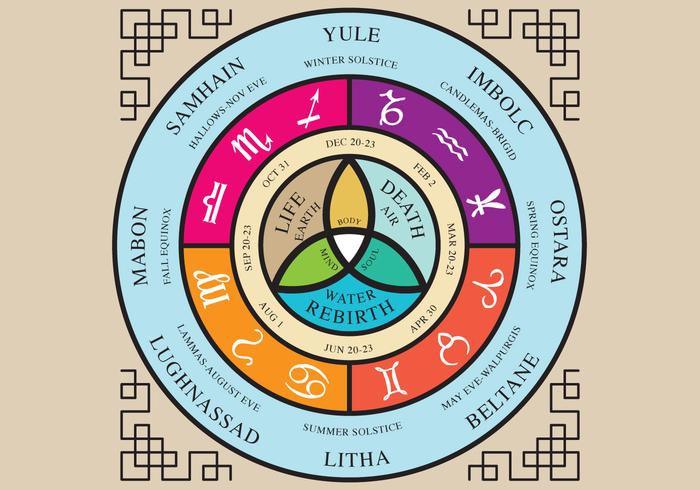
I’m a Wiccan by faith (Unitarian Universalist by church home), so an important issue I’m grappling with here in New Zealand is how to adapt my practice to the southern hemisphere, where seasons are flipped. While pagan bloggers down here recommend following the seasons as they come, since the Wheel of the Year is based in the natural cycles of growth and dormancy, it’s tough to uncouple the dates I’ve followed since I began this path in my teens. Finding meaningful connections in a new environment will be the project of many years to come.

A circle with four concentric circles. The outer blue one has the names of the pagan seasonal holidays, the second has the astrological signs associated with each quarter of the year, the third has the Northern Hemisphere corresponding dates to the holidays, and the center has a trinity knot marking the phases of life, death, and rebirth, and the elements of each season.
The Wiccan Wheel of the Year (with date associations for Northern Hemisphere)

I feel very much connected still to my northern home, in part thanks to the magic of the internet. I can imagine and remember the deep freeze in Minnesota and Wisconsin, and it’s easy to picture myself bundled up and weathering the polar vortex with that “cold enough for ya?” camaraderie.

And amid this dark, frozen time of year arrives a particularly significant pagan holiday on my calendar: Imbolc. It’s known as Candlemas in both pagan and Catholic tradition, the day of the year when all the ritual candles for the coming year are blessed in the first days when the return of the sun can be perceived. It’s light just a little earlier today, and dark just a little later, but the trend toward long sunny days reveals itself around February 1. (This is also how Groundhog Day becomes a holiday about a rodent seeing its shadow on February 2.)

A woman in a snowy forest. She's dressed in a warm dress with fur at the collar and wrists, with a crown and necklace of branches and berries. She looks down at a candle she holds, its light and heat wafting out into the winter backdrop. Her hair rises in a similar flame-like way, red and gold like fire.
Brigid sparking light in the winter.

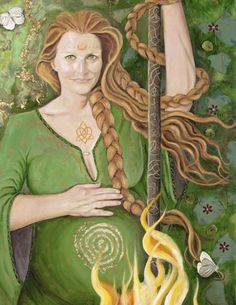
It’s also (St.) Brigid’s Day, celebrating the Goddess’s return to the virgin girl, fresh with promise yet to be realized, her capacity for fertility and ripe abundance still latent. B is my homegirl; the Irish goddess and saint are inextricably entwined. The saint’s patronages are identical to the goddess’s domains: home and hearth, pregnancy and childbirth, fire and poetry. This time of year is for her and her boundless potentiality.

But here in the upside-down, today is most definitely Lammas (or Lughnasadh), the festival celebrating the harvest’s first fruits. We’ve been gorging on summer fruits and herbs all along, but only now are we able to enjoy some of things that needed the whole warm summer to ripen. We can sink our teeth into apples and sweet corn we haven’t seen since this time last year, even while the days are still long and the air is still warm.

So how do I reconcile two holy days that seem at such odds? The connection that’s helping me make sense of today’s contrast is my experience as a mother now. I’m watching my sons launch themselves more bravely into the world. They’re already their whole selves but still have many experiences to grow into. It’s back-to-school time, a bigger leap than usual as my sons start at new schools in a new country, looking for their place and the friends they’ll find there. Of course, this reminds me of myself at this age: told since my first years about how much potential I had, and seeing the first glimmer of what’s ahead in adulthood. And of my own mom, how she must have felt at this stage as both the girl and the mother.

A woman with long, red, braided hair and a green dress stands with one hand on her pregnant belly, the other hand holding a carved staff beside her. A bowl of fire rests before her. Her forehead bears a golden moon crescent, her chest has a golden Celtic knot on it, and her rounded belly has a golden spiral.

Brigid can see the light at the end of the tunnel of childhood that’s protected and sheltered her as she grew into her whole self. She can imagine the first fruits of the hard work of growing up. And the mother at Lammas can look back and see herself at that age, and forward at the harvest to come that sets another person on their own path. The returning light in the north flies like an arrow loosed into the south’s first abundant harvest. And I know it was Brigid launched that volley of fiery hope.

Auck’ward: The Mother Tongue

This is my first attempt at writing about the multicultural society here, and it certainly won’t be the last. I’ll be learning the ways Maori and other Pacific cultures are embedded and interpreted in New Zealand for the rest of my life. I’m coming at this as someone who’s been a little more than casually interested for a long time, but who’s observing and experiencing the extent of indigenous culture on the broader New Zealand society for the first time.

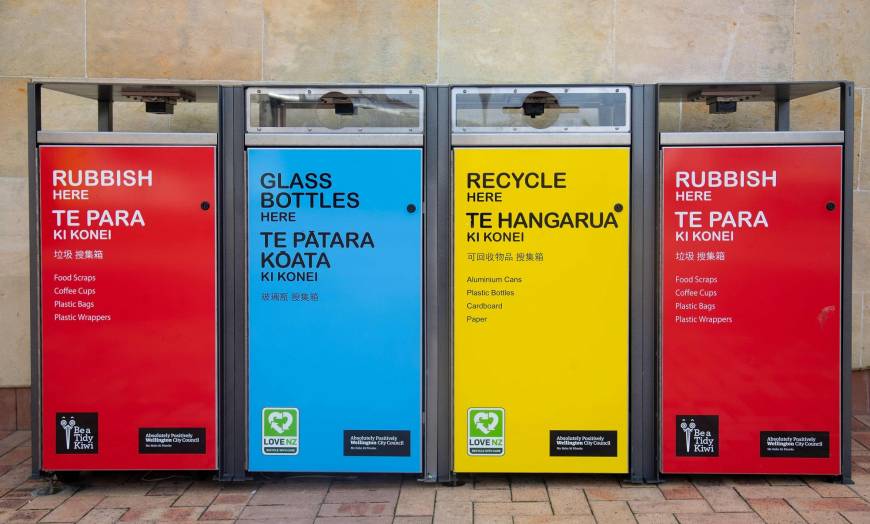
Four public trash and recycling cans, red, blue, yellow, and red. At the top they're labeled in English; beneath that in Maori; and beneath that in Chinese.
Municipal trash and recycling bins, labeled in English, Maori, and Chinese.

New Zealand is a bilingual country, with all government publications and services bearing messages in both English and Maori languages. Kids learn Te Reo Maori (“the Maori language”) words, phrases, and songs from the day they enter school. Signs in libraries and community centers and public swimming pools are labeled in both languages. And many places retain their original Maori names.

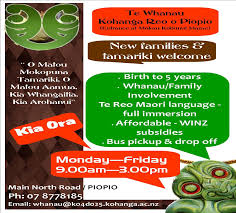
A busy advertisement for a community daycare offering full Maori immersion. The ad incorporates a number of Maori phrases, words, and cultural symbols like carved green Tiki heads.
Advertisement for a daycare center offering full Maori immersion.

The integration is more than official. Maori words crop up in Kiwi conversations all the time. Folks inquire about your family with “How’s the whanau?” Stores with calligraphied photo frames and plaques have “arohanui,” or “much love,” alongside the “love makes a family”-type stuff.

An artwork with panels in various colors and patterns, such as a dove, two white-skinned hands clasping, flowers, and the word "Arohanui."
Artwork featuring the Maori expression “arohanui,” or “much love.”

As someone who’s dedicated a lot of years to reading, writing, and speaking languages beyond English, I really love seeing Maori in print everywhere. I’m watching a bunch of shows on the Maori-language TV channels, and I’m working hard to get my pronunciation and vocabulary right. It’s the one part of indigenous culture where I have more clarity about what’s appropriative and what’s not.

Most importantly, though, is the fact that Maori’s omnipresence means that there’s no mistaking that indigenous people, their language, and their culture are alive and well, now and into the future. It’s a stark contrast with Native American people and cultures in America, where place names are obscured or unmoored from their origins, and Native people are rarely portrayed in the present day by mainstream media.

The differing paths of colonization have everything to do with this contrast. But New Zealand offers a vision for how language can be used to stitch together the past and present and offer a way forward as a bilingual and bicultural society.

Auck’ward: The Burning Daystar

The sun in New Zealand is not messing around.

That seems like an absurd thing to say, but it’s absolutely true. The sun isn’t that friendly yellow circle on kids’ drawings. It’s a vicious predator that will not be stopped.

It’s not the amount of sun we get. It’s the intensity. Once, I sat outside with my book, and I propped my feet on another chair. Five minutes later, I could feel my shins scorching. My shins.

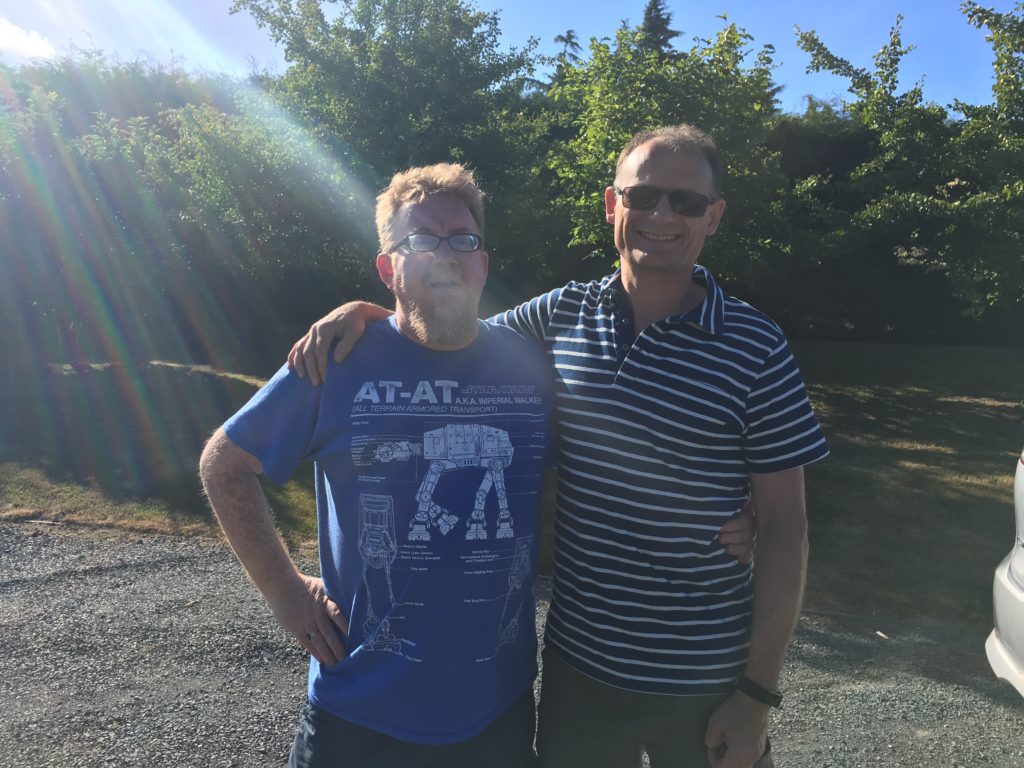
Look at the sun attacking this poor ginger guy and his mate.

Peak UV levels here are 40 percent higher than at the same latitude in North America, and New Zealand has the highest rate of melanoma in the world. Folks take sun exposure very seriously here. Rash guard shirts and full-on wetsuits are for sale in every swimwear section. Homes often have a pump bottle of SPF 50 the size of a mayonnaise jar in Iowa. Long-sleeved shirts and pants are common at the beach. And lots of people wear brimmed hats–you can even buy them as part of kids’ school uniforms.

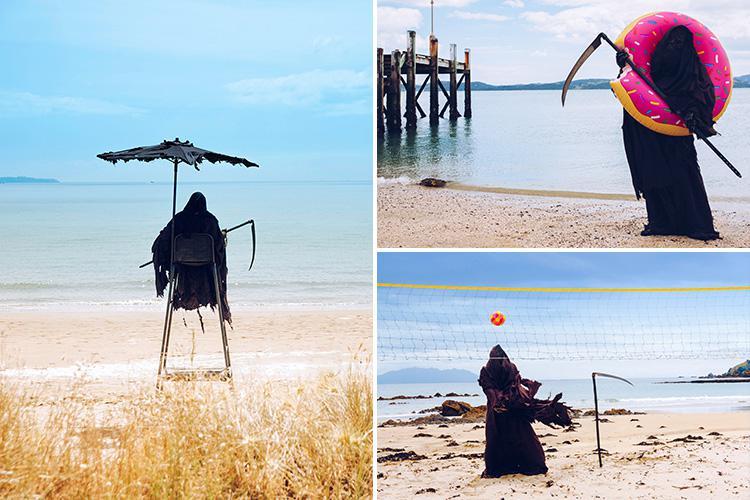
Okay, skin protection isn’t THIS over the top here.
(The Swim Reaper is a character in a Water Safety New Zealand ad campaign.)

The atmospheric conditions cause the severity of UV radiation here. There’s still a major hole in the ozone layer, but it’s over the continent of Antarctica. That said, “plumes” of ozone-depleted air can wash up over New Zealand, thinning the atmosphere so more UV rays get through. The lower concentration of air pollution here actually lets in more UV rays as well.

And try as I might, no matter how well I SPF it up or cover up, the sun is determined to leave a mark. As a person with the approximate skin color of a recently drowned person, I feel targeted. I know it’s coming for me. And when I let my guard down? It will attack with extreme prejudice.

Jan 9, 2019 - New Zealand Studies    1 Comment

Auck’ward: I’m Lovin’ It

A typical red McDonalds sign with yellow arches that reads "Macca's" instead.

I thought, “How should I show my New Zealand assimilation? I’ll write about McDonalds!” Obnoxious American powers, activate!

Say what you will about global fast food chains, but they accomplish a paradoxical feat: they’re all gloriously the same, and they all differ to fit the culture where they find themselves, at the same time. Videos exploring those regional differences are fun to watch, and I always find a new variation I wish was widely available (McD’s chicken katsu burger from Japan, people). But when you want a taste of America, there’s nothing like crappy food from an international corporation.

I bring glad tidings from New Zealand, though. McDonalds here is so much better here.

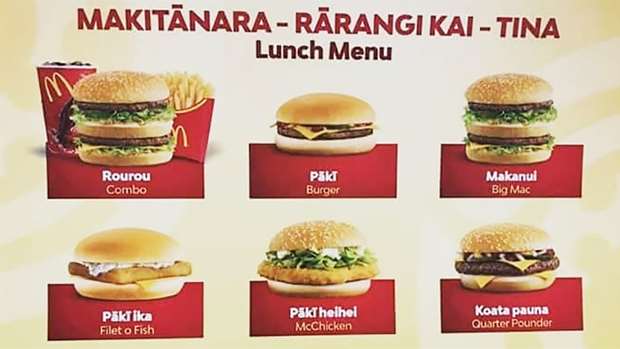
Bilingual Maori/English McDonalds menu with six most famous burgers.
Menu in Te Reo Maori from Hawke’s Bay.

A couple of factors are at work here. First and most importantly, corn syrup is banned here. Everything is generally less sticky sweet. Coke is made with cane sugar, so it tastes more like MexiCoke. (Do a taste test if you’ve never experienced the difference.) Tomato sauce (a.k.a. ketchup) is more savory. Peanut butter is hardly sweet at all. You can get these things American-style, but you’ll have to go to a specialty international foods store.

At McDonalds, this manifests in some interesting ways. First, the french fries are paler. They don’t get that sugary spray before freezing that caramelizes in the fryer and makes them look golden brown. So fries here are a little floppier and a little whiter, but the potato flavor is stronger. Sauces are better too. The sweet & sour dipping sauce tastes more like orange chicken. I’m sure these things are still a nutritional disaster, but they taste more complex than just pure sugary syrup.

Regional menu items are pretty great. New Zealand has this thing about beets (that’ll be a whole different post down the line), so the Kiwiburger has a big slice of beet and a fried egg in addition to your basic toppings. There’s the Big Brekkie burger, which has a fried egg, hashbrown, bacon, BBQ sauce, and cheese on top of the burger patty. The lime shakes are a huge hit with my kids. Ice cream cones come dipped in chocolate if you want, or with a piece of Flake chocolate bar.

Finally, and I find this weird and hard to explain, but you can customize your sandwiches to an absurd extent. Sure, it’s cool when you can swap out beef patties for Filet-o-Fish patties on your Big Mac. But do you want four beef patties on your Big Mac? Easy. Do you want a grilled chicken breast on your Quarter Pounder? No problem. Do you want alternating layers of fish and chicken and fried eggs? Here you go. This blows my mind, especially in contrast to the fact that all other portion sizes are small (no super sizing here).

It is absolutely no help to anyone that the back gate of our yard, toward the bus stops and grocery and library, opens into the parking lot of a McDonalds. It’s going to get worse when the kids start coming home from school. But it’s a taste of home, both in America and right here in New Zealand.