Tagged with " politics"

Bite Your Tongue

I’ve been on hiatus here at the blog for a while, as summer (and more specifically, con season) made all our best laid plans gang well and truly a-gley. Having been deprived of Gen Con, I set out to give the boys a few firsts, including first time on a horse and first time in a human-propelled watercraft. They both went surprisingly well.

I’ve also been doing lots of work with Minnesotans United for All Families–not particularly more than before, but the campaign has reached critical mass, and every day it seems there’s movement or news.  I had to tell the boys to stop yelling excitedly every time they see an orange “Vote NO” lawn sign, as they started springing up like mushrooms all over Saint Paul, and I began to rapidly lose my hearing. There’s great cause for hope, but it’s going to be close, and we’ll be working flat-out right up to the night of November 6.
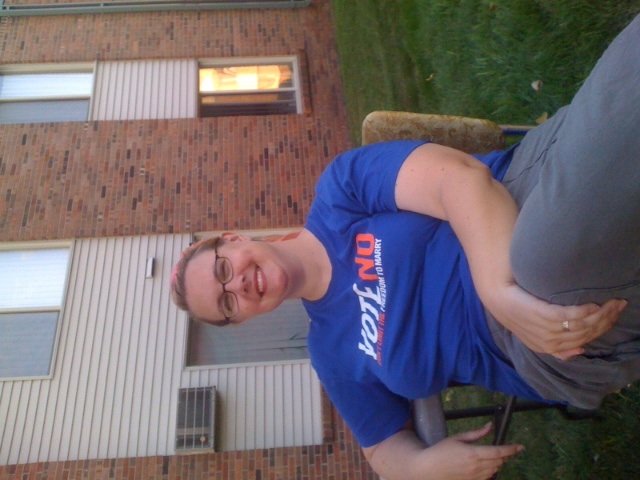
(Wo)manning the MN United table at our apartment complex’s National Night Out event. Picture by Griffin.

The heart of my work is having conversations with Minnesota voters, and teaching others to do likewise. It’s so different from other political advocacy I’ve done in the past, as I’ve described previously, and instead of coming home exhausted and drained, it usually takes me an hour or three to come down from the adrenaline high after a phone bank or training. I’ve met fantastic people of every age, faith, place, and life experience, and whatever the outcome of the election, I believe we’re fundamentally changing the way Minnesotans think about each other, about marriage, and about lesbian, gay, bisexual, and transgender people, for the better.

Time and again, though, in my own conversations and the ones I’m training people to have with their friends, family, and neighbors, this question comes up: “What do you say when someone says marriage has always been that way and starts quoting Scripture?” To which I always reply: “You’ve got to bite your tongue, just like I do.”

I know, you’re saying, “You, Jess? You just bite your tongue when it comes to a question of religion and history?” And yes, I really do, hard as that may be for you to picture. In fact, that’s the major skill set I’ve been working on personally in this campaign, and I’ve made real strides in this department.

But why, you ask? Why don’t I lay The Almighty Bible-quoting, chapter-and-verse, dates-and-names-and-edicts-and-Supreme-Court-cases Smackdown To End All Smackdowns on them? I admit, the urge is strong. Sometimes, it feels like a whole segment of the population is just BEGGING me to teach them the history their schools and churches have failed to teach them. It seems like a personal sign from the universe that my particular combination of research is meaningful and needed, right here, right now.

But I’ve discovered something else that’s meaningful and needed, right here, right now: I’m not going to win a single vote for marriage equality by “changing minds,” which is what I’d be trying to do if I gave in to the impulse to lecture. The only way we’re going to defeat this hurtful amendment is to change hearts, and all the knowledge in the world doesn’t even scratch the surface of that mission.

I just finished reading a fascinating book by social psychologist Jonathan Haidt, called The Righteous Mind: Why Good People Are Divided by Politics and Religion. I haven’t felt like assigning required reading to everyone I meet in a while, but if I could buy this book for everyone I know–especially those on the campaign with me–I would. Haidt makes the case for a hybrid definition of how the human mind works, somewhere between Plato’s assertion that emotions are the servants of Reason and Hume’s argument that Reason is a slave to our passions. Haidt says a more apt analogy would be an elephant (our emotions) with a rider (our intellect). The rider can make suggestions to the elephant and looks like he’s in charge, but ultimately, if the elephant decides to head a particular direction, all the rider can do is say “I meant to do him to do that.”

Haidt also shares the results of his research into the moral foundations on which the edifices of conservative and liberal thought are built, and his conclusion is that part of the success of the modern conservative movement is based on the fact that conservative ideology appeals to a broader array of moral options than liberalism does. Since liberals often think of conservatives as “narrow-minded,” this sounds counter-intuitive, but really, it’s not. Liberals, Haidt demonstrates, derive their moral judgments almost entirely from whether something cares for or harms other beings, or whether it seems equalizing or discriminatory. Conservatives, on the other hand, respond less strongly to equality and care/harm, but additionally respond to messages of proportionality (more/less work=more/less reward), loyalty (to kin and other identity groups), sanctity (upholding standards of purity or pollution), and authority (respect for institutions), while many liberals actually perceive a threat from high degrees of those sources of morality. I think he’s really on to something, and I agree with what I heard Howard Dean talk about in a speech at Penn State, all the way back in 2004–that progressives won’t be able to accomplish their goals until they learn to articulate the morality of their position from all of these angles, and tap into the emotional heart of their message.

So when I talk to people about the anti-marriage amendment, I’m consciously talking to the elephant, not the rider, because it’s the elephant that will check a box on the ballot November 6. What does that mean, practically? It means I ask voters how they feel about love, marriage, and commitment, not how they think. I ask them if they’re married, if they’ve ever been in love, if they’ve ever been to a wedding, and how those things felt. I ask them whether they know any gay people, and how they feel about them if they do. If they say they don’t, I ask if they’ve ever felt excluded from something they wanted with all their hearts. And I don’t take no for an answer, because that experience is just as universal as love.

What I’m specifically not asking about is what they’ve been taught, what they’ve learned, what they know about the law and history of marriage. I’m not informing them on marriage’s roots in civil, economic, contractual law. I’m not engaging in Dueling Scripture Quotations. I’m not expounding on the long, twisted history of suppression of rights for groups that aren’t rich, white, male, or Christian. I’m not doing any of that, because it’s an absolute waste of my time, and I don’t have a minute to waste between now and the vote. There’s no point in convincing the rider, because there’s no way he can convince that elephant to squeeze into the booth if the elephant’s not into it.

The way we’re going to win is make the elephant want to get into the booth, and the only way to do that is to tie marriage equality to something the elephant already feels strongly about. Everybody wants love; nobody wants to be told they’re not good enough; we feel strongly about commitments to the people in our lives. Occasionally, I’ll come across a person whose church is democracy, whose scripture is the constitution, and for them, talking about rights and fairness is as persuasive as showing them how this amendment harms the people they love. But that feeling isn’t nearly as universal as the desire for love and the dream of celebrating that love in the sight of family, friends, community, and (for many) their god(s).

So I bite my tongue, and the teacher in my head jumps up and down furiously at being stifled. But the blood I taste is worth the stories I hear, the hopes and fears people share, and the wonder of creating a connection where there wasn’t one before. Those are the things that will get the elephant in the booth, and help generations of Minnesotans know that they are welcome, valued, and loved in this beautiful state of ours.

Aug 1, 2012 - Political Science    2 Comments

Politics Most Fowl

I’m going to come right out and say this:

I don’t like Chick-Fil-A.

I mean, I really don’t like their sandwiches. I’m pretty sure no one but me cares, and that’s fine.

No, I’m not just piling on the little guy (if a corporation can be a “little guy;” Citizens United be damned), and I would die for the company’s president to say whatever damnfool, hateful nonsense he wants. This is America, and both religion and speech are still free, even inhumane and cruel religion and stupid, self-serving speech. I just think their chicken tastes like crap.

But in the noise and the furor over the statements and counter-statements, the protests and counter-protests, I only have a few things to add, all of which are unsophisticated and not worth arguing over.

1)  Boycotts work. If you don’t agree with a company’s politics or actions, don’t give them another dime. Yes, the first place they feel it is in local franchisees, and that’s maybe not whom you want to hurt when you drive on past. But corporate offices sure as hell notice boycotts, and they are incredibly powerful tools of protest.

2) Be kind to the people who work for the corporation you’re targeting with your protest. I’d be willing to guess that there are a lot of people who work for Chick-Fil-A who work there because it’s a job. They’re mainly college kids trying to scrape up tuition money for next semester, senior citizens whose Social Security wouldn’t keep them in food AND meds, and a whole bunch of underemployed people who just need a steady income as they come out the other end of the financial disaster we’ve just weathered.

They’re not anti-gay; they don’t value anyone less than another. (Though there is this, which is a little weird.) They’re scared as hell that someone’s going to belly up to their counter today and release a spew of bile and invective at them, and hold them accountable for something beyond their ken. And that spew goes both ways. Imagine the pain of having to suffer through some bigot’s tirade about gays going to hell, followed immediately by an irate liberal’s rant about how they’re a horrible human being for taking a paycheck from a company that crushes the dreams of little gay boys and girls.

I get queasy just thinking about that level of confrontation, all day every day.

So, if you want to make a big scene, for god’s sake, don’t drop a glitterbomb on the counter at a Chick-Fil-A. Some kid with developmental disabilities, on loan from the local group home, is going to have to sweep up every single flake before he can claim his discounted, hours-old, half-cold, slowly-lethal chicken lunch in the janitorial closet. That’s the way fast food works, and you’re not punishing the right person.

Just got to make a point? Grab your best friend, ask to see the manager, kiss that friend right on the mouth, and tell them that you love everyone. And then go home and cook dinner for your family.

Correction: Don’t just kiss your friend–hug the manager. Tell him/her how sorry you are that the company owner put their business in this position. Then donate the cost of your meal to one of the marriage equality fights in the country right now (in Washington, Maryland, and Minnesota). And THEN cook dinner for your loved ones.

Excuse me, I’m having a moment here

You know those people who always say, “There’s a reason for everything that happens?”

Yeah, I usually want to kick them in the crotch, too.

But even as I say that, I have to admit that I’ve seen meaningful patterns in my life, time and time again, for which there’s no rational explanation. Doors closing, windows opening–call it what you will. I’ve just found myself in too many places I shouldn’t have been that turned out to lead me to exactly where I was meant to be.

That’s why, when people ask me if I could “take back” my sexual assault or my fibromyalgia or the hell we’ve been through with Connor, I answer, fast as a snap, “No!” Those things made and keep making me the person I am, and I love where and with whom I am far too much to risk changing even one crappy thing in the past.

For the most part, I perceive these patterns from afar, like an aerial photograph of where I’ve been. But I’m in the midst of an amazing moment right now, when I see them crystallizing right before me. I am precisely where I am supposed to be, where I’ve been headed for decades.

I’m volunteering for Minnesotans United for All Families, the coalition fighting the constitutional amendment that seeks to limit the freedom to marry in Minnesota for generations to come. It’s on the ballot in November, the 31st of these elections when a basic human right for a whole group of people is put up for popular vote.

We aim to be the first to defeat this kind of attack.

I’d already committed to be part of this effort, but when one of the organizers here in Saint Paul came to me to ask if I would step up as a team leader and put in about 6-8 hours a week on the campaign (until it becomes much, much more, when the leaves start falling from the trees). Frankly, I might’ve been smarter to say no, but I’d wanted a way to engage more with the campaign so, like the Overcommitment Princess I am, I said, “Bring it.”

I’ve attended trainings and phone banks, planning meetings and launch parties. I’ve met more new people on the campaign than I may have met in the whole time I’ve lived in Minnesota. They’re running a crazy-smart campaign here, unlike anything that’s been attempted anywhere else, focusing on personal conversations about love and commitment, rather than discrimination and legal protections, with over 1 million voters. And the longer I’m in this thing, the more I know that the skills I’ve acquired all come together for this work.

A lot of the work is very similar to teaching. Informing voters, training volunteers, and coordinating teams has shades of lecturing, discussing central concepts, guiding and supporting folks so they can reach their own conclusions on the subject. I appreciate my experience with non-traditional students and different ethnic constituencies–this coalition is so broad and deep, uniting across so many communities.

I’m finding my crisis counselor training to be very useful too. Having intense conversations about values with strangers, neighbors, and friends, as well as training others to have those conversations, requires active listening, something that doesn’t (but should) get taught in everyday life. It’s hard not to use my Rogerian reflective statements, but I’m allowed to get invested in the stories I’m telling and hearing in a way I couldn’t as a counselor. I’m walking with people through memories, and feelings, and judgments that sometimes unravel or take shape at the same time as the words cross their lips. It’s incredibly powerful.

And I’ve already expounded on my commitment to philanthropy and social justice activism here on the blog. Though I still feel guilty when I try to own my bisexuality because I’ve never suffered for that part of my identity, this isn’t only an LGBTQ issue. All you have to believe in to fight this amendment is love. I’m living my happily ever after, despite very long odds–I want everyone to have the same freedom and joy.

Even my training as a historian gives me perspective that adds to my sense of privilege at being a part of this. In my religious studies work, I’ve looked at the civil terms and religious blessings on personal commitments in a wide variety of cultures and eras, which is powerfully erosive of many arguments in favor of such an amendment. And knowing the history of milestones like the Loving v. Virginia case, which made interracial marriage legal for once and for all in America in 1967, has opened my eyes to the historical importance of halting the tide of these amendments at last.

So I’m having a moment here. Minnesota’s having a moment too, deciding what kind of state it wants to be. But my moment (as egocentric as it sounds to say it) is more empowering than I think anyone at Minnesotans United knows or cares. I doubt my qualifications, my value, my ability to be useful to anyone, all the time. Every time I recommend myself for something, my heart’s in my throat like I’m jumping off a cliff. I even feel weird thinking about getting business cards made up, because honestly, who would ever want or need to remember me enough to keep my stupid square of cardstock?

But on this campaign, I feel useful. I’m doing good work. I can contribute my skills and my passion, and have it matched and encouraged and appreciated. I feel needed–me, with my quirky, particular bag of tricks. I’m so grateful for the experience that I even offered to dye my hair back to a plausibly human color, if they thought that the coding that happens on first contact would be detrimental to my ability to help effectively. Their response? “No way. Rock the pink hair. We need the pink-haired to feel included too.”

That’s love, folks. That’s what we’re fighting for. And what I’m doing will help us win.

May 31, 2012 - Social Studies    15 Comments

Walking the Talk

I’ve been trying to string these observations together for three days now, and failing utterly to find a single narrative thread. But I really feel the need to get these ideas out there. So, instead of a coherent blog post, you get a bunch of random thoughts about the complexities of race relations. My apologies.

******

Rev. Mark Morrison-Reed and me, May 2012

I’m thinking a lot about race these days. Part of that is deliberate. I took part in a study group about the racial history of my religion, Unitarian Universalism, at church, in anticipation of a weekend visit by the foremost historian of the African American UU experience, Mark Morrison-Reed. We read his book, Darkening the Doorways, and discussed everything from white privilege, to assumptions about what black visitors to our church would find welcoming, to outreach efforts to walk the talk on multicultural engagement.

The accompanying workshop, and the extended conversation for the group of us, was difficult and painful, but soul work really should be. The first principle of our faith is that we honor the inherent worth and dignity of every person, but we’ve been unsuccessful more often than successful at truly embracing real diversity in our church homes. We’re so much more comfortable going into communities of color for a day of service–us doing things for them, not with them–then returning to our monochromatic congregations on Sunday with the glow of righteousness.

The main conclusion we came to that day, with Mark’s help, is that communities of color are used to people coming and going. What they’re not used to is people staying. Volunteers paint buildings and plant gardens. They don’t come back to touch-up or weed. It’s the same with political work. Don’t just show up for the march–come back for coffee, stay for dinner. Don’t just make speeches–ask what they want, and listen as long as they want to talk.

 ******

I’m not colorblind. My stepdad says he is, with ridiculous statements like, “I don’t see race” and “There’s no such thing as black and white–we’re all cocoa, vanilla, cream tea, cinnamon.”  It sounds delicious, but it’s hard for me to reconcile this kind of obliviousness with his history as a young white man who stood up for civil rights in the ’60s. He even attended Dr. King’s “I Have A Dream” speech. To me, this is blindness, not color blindness, and it diminishes the real struggle people of color have had and continue to have in America. Is this a relic of that generation of liberal speech on race? Did it sound as insensitive in the past as it does now?

 ******

I see race because I see patterns. As a kid, I was curious about things like melanin, epicanthic folds, and naso-labial shapes. But I was far more fascinated by the differences than worried about them. I noticed that people of different ethnicities smelled differently, and I wanted to taste the food I scented on their clothing and in their hair. I collected dolls dressed in the native costumes of different nations. I spent hours in a Chicago-area children’s museum, acting out family life from Fiddler on the Roof in the kid-sized Jewish home, and making tortillas and touching all the weavings in the Mexican home. And my mom tells me that, around the age of 2 and 3, I would babble incessantly in some weird language, then sigh in exasperation when she told me to stop talking nonsense. “*Mo-om*, it’s not nonsense,” she says I said, “I’m speaking French.” To this day, she wishes she’d known someone who spoke French, to find out if I actually was.

 ******

I worked in a record store at the last year of my undergrad work, in Lawrence, Kansas. I loved my job, but I’d watch the kids who browsed a little too long in the Rap/R&B section. The white boys were so stupidly obvious, all I had to do was walk up to them and ask them how I could help to get them to mumble nervously and quickly leave the store, their shoplifting plans foiled. When it was young men of color, I’d watch them, then deliberately turn away, telling myself it wasn’t fair to profile them thus. After they left, I’d do a quick check of the section, and when I found neatly razorbladed magnetic tags or plastic wrappers stuffed into the corners of the racks, I was furious and hurt. I hated that they reinforced the negative stereotypes, justified my profiling, and made me feel racist and ashamed.

 ******

I just read a book by John L. Jackson, Jr. called Racial Paranoia: The Unintended Consequences of Political Correctness, in which he makes a compelling case that, in the wake of the advances at exterminating de jure (in the law) and de facto (in reality) racism, all the remaining ambivalence gets internalized into what he calls de cardio (in the heart) racism, which isn’t even always conscious, and will be much harder to stamp out. Jackson posits that, if people on both sides of the color line can’t trust people to speak the truth about race, they come to mistrust everything they say about race, leading to deep racial paranoia.

Mind=blown.

The book taught me about the propensity to believe in vast conspiracies, based on this fundamental mistrust, and the books and music who advance these theories in the black community. I felt about a dozen questions and observations snap into place, finally in context, with each chapter. And his theory confirms my suspicions about the direction public attitudes about LGBT folks are headed, as it becomes increasingly less acceptable to openly discriminate. In this way, among so many others, we have to acknowledge that civil rights are civil rights are civil rights.

******

Few things make me as frustrated or embarrassed as seeing white people co-opting pieces of other cultures as their own. Purely Euro-American people drumming in sweat lodge retreats at expensive resorts. Suburban soccer moms who say they understand Latinos because they’re sending their kids to a Spanish-immersion private school. Kids putting on the swagger and language of inner city culture, without having to suffer any of the doubt and fear that comes with walking through gated communities while black.

A few years ago, I heard someone ask, “Why is cocaine so addictive and damaging, when South Americans chew coca leaves for years and never suffer ill health?” The answer is simple. Because when you take something out of context–extract, distill, purify–you may amplify the parts you want, but you lose hundreds of organic compounds that balance and mitigate the downsides in ways we don’t even fully understand.

Culture works the same way. When you sample ideas and practices out of context, you may feel enlightened and energized by your new, hip, exclusive experience, but you’re missing the point, and denigrating a culture that’s richer than you even know. Admire Native American spirituality? Learn about rez life. Like to sing African American spirituals? Learn about the black experience of Christianity and liberation theology. Do the work, and learn the context.

 ******

I’m not trying to “put on” blackness, with all these inquiries into race lately. I want to understand a culture that is, in so many ways, hidden in plain sight. I want to understand how people of color experience the same things I experience, each of us through our different lenses. Those lenses are ground by things like dinner table conversations, schoolyard lessons, the looks you get (or feel) walking down the street, and how it feels to stand on thresholds real and metaphoric.

I’ve experienced the world through the lens of white privilege; I know that deep in my bones. I don’t feel guilt, but I do feel regret. I’ve also experienced the world through the lenses of being female, being autistic, being liberal, being curious. I want to hear the voices, and I have a deep desire to reach across that divide, as much as I would be welcomed, to speak to and embrace the common humanity of us all. I’m not satisfied with the boundaries others tell me are “safe.”

 ******

I am happiest when my world is diverse. And I want my boys to grow up thinking that friends come in every shape, gender, color, physical ability, and personality. When they were younger, I took them to the parks where the immigrant families came for day trips, up from Chicago. A lot of the locals in our lily-white resort town told us to avoid them on weekends, but I wanted my sons to smell different cooking, hear different languages, and play with every kind of kid. So many families welcomed my wild, gregarious sons, and seemed delighted with the mingled laughter and fun of their children and mine.

When they ran over to ask if they could play with a new friend, I asked them to point out at least one of the kids’ parents. They would point vaguely, eager to return to the game, and say, “His dad is the one in the green shirt” or “His mom has long hair.” I would follow their little pointing finger, and as often than not, the man in the green shirt was also black, or the woman with long hair was dressed in a sari. But those things didn’t register as different enough to remark upon, and skin color was irrelevant, next to the possibility of a new playmate.

Am I wrong to be proud of that? I don’t want to seem self-congratulatory. But teaching values to kids is such a fraught proposition, and the way they treat others–especially perfect strangers–is one of the real litmus tests for whether your lessons are sinking in. They’re a big part of why I want to expand my circle of friends and contacts to include more people of color. The indifference to difference doesn’t last forever. It’s time for me to put my body and heart where my values are, for them to see.


Before the Ballot: Friday Night Lists

Every presidential election year, I assign myself a whole pile of relevant non-fiction books as my Election Year Reading List. Some of them are topical; some are great political, sociological, or economic minds; and some are just strong liberal voices that clarify the values that motivate me to pick up my clipboard and get to work. I thought I’d share this year’s reading list, and a few important pieces that are still relevant from the ’08 list.

I’m putting this list in the order I’ve read them so far; those I’ve read will be marked with asterisks. Totally at random, the order of #2-5 has worked out very serendipitously, so if you decide to read these, let me recommend that order. I’ve already made quite a dent in this year’s list, so I could use a few more suggestions to fill it out through November, especially in specific issues of foreign affairs. I’m also always willing to read different points of view, so long as they’re rational, fact-based, and not overly polemical. You can leave your recommendations in comments, or friend me on Goodreads so we can see each other’s lists.

2012 ELECTION YEAR READING LIST

*1. Hostile Takeover: How Big Money and Corruption Conquered Our Government–and How We Take It Back by David SirotaSirota, a progressive radio fixture,  offers a good basic primer of how money affects every branch of the government, from local to federal, and suggests some common-sense, achievable solutions to reverse that trend.

*2.  Tear Down This Myth: How The Reagan Legacy Has Distorted Our Politics and Haunts Our Future by Will Bunch. This book by Bunch, the Philadelphia Daily News senior (and former political) writer and Huffington Post columnist, sets out to remind its readers of the realities of Ronald Reagan’s background, politics, and actions as president, untangling him from the distortions the man and his record have been subjected to in recent canonization efforts. The book’s definitely critical of Reagan, but the history review is good, and serves to point out just how far left of today’s conservatives Reagan really was.

*3.  Griftopia: Bubble Machines, Vampire Squids, and the Long Con That Is Breaking America by Matt Taibbi. The Rolling Stone columnist delves deep into the mechanisms and psychopathic personalities that led directly to the 2008 economic meltdown. Taibbi’s wacky, profane style keeps the economic explanations from being dry, and he’s got a real knack for capturing characters that make you want to tear your hair out.

*4.  Drift: The Unmooring of American Military Power by Rachel Maddow. Headliner on the MSNBC primetime line-up, Maddow‘s first book puts her ferocious intelligence on display as she traces the transition of the US military from the all-volunteer force of WWII, through the Vietman Era, into the privatized professional military with its overused, sequestered backbone of soldiers of today. She ends with a few good actions to begin reversing this trend toward permanent war.

*5.  With Liberty and Justice For Some: How the Law Is Used to Destroy Equality and Protect the Powerful by Glenn Greenwald. The tightest-written and most persuasive book I’ve read in a long time, Greenwald, a widely respected Salon.com contributor, lays bare the subversion of our justice system to protect the social, political, and economic elites from the reach of the law.

6.  The New Jim Crow: Mass Incarceration in the Age of Colorblindness by Michelle Alexander. I think the racial disparities within our justice system, and the private for-profit incarceration industry, comprise one of the most important issues in American society today. I saw Michelle Alexander, a professor of law at Ohio State and a Huffington Post contributor, speak on Melissa Harris-Perry’s show, and I’m braced for a hard, harrowing, eye-opening read.

7.  End This Depression Now! by Paul Krugman. A New York Times columnist and Nobel Prize winner in Economics, Krugman is the hero and standard-bearer for modern Keynesians. I trust his analysis without reservation, and I’m very interested to see his prescriptions for the short- and long-term changes that our economy needs.

8.  Pity the Billionaire: The Hard-Times Swindle and the Unexpected Resurgence of the American Right by Thomas Frank. I loved Frank‘s earlier book (see later, in the best of ’08 list), and I’ve heard him speak on the current one on NPR a few times. He’s got a way with case studies and relating them to broader trends, and the examples of “broke” billionaires and the trappings of that culture I’ve heard him talk about just blew my mind. I expect this book to be funnyhorrorsad.

9.  The Righteous Mind: Why Good People Are Divided by Politics and Religion by Jonathan Haidt. I first encountered Haidt, a professor of psychology at the University of Virginia, on The Colbert Report, and I’m wildly intrigued by his work on identifying the psychological underpinnings that make political and religious zealots so similar.

10.  Chasing Ghosts: Failures and Facades in Iraq: A Soldier’s Perspective by Paul Rieckhoff. I respect the hell out of Rieckhoff, a retired Army specialist and one of the founders of Iraq and Afghanistan Veterans of America. I’ve read a lot of about the wars and today’s military by civilians, but I always want to get a balanced view, and I’m looking forward to his smart insights.

11.  Beyond Outrage: What has gone wrong with our economy and our democracy, and how to fix it by Robert Reich. Reich, Clinton’s former Secretary of Labor and a current professor of economics at UC Berkeley, dazzles me with his talent for condensing complex facts into easily understandable patterns. He’s a good Keynesian too, like Krugman, but add in his expertise on labor history and government experience, and you’ve got an expert I’ll always stop to watch/hear/read.

12.  The Price of Civilization: Reawakening American Virtue and Prosperity by Jeffrey D. Sachs. I heard Sachs, a professor of health policy and management and director of the Earth Institute at Columbia University, speak on MPR, and I spent most of the hour with goosebumps from his smart, impassioned argument for the restoration of the real American values that made us great in the 20th century. After all the previous books help me get a grip on the scope and details of many problems we currently face, I’ll be ready for his strong restatement of our core values.

13.  Back To Work: Why We Need Smart Government for a Strong Economy by Bill Clinton. Similar to Sachs’ book, but obviously from a very different perspective, Clinton‘s most recent book should offer lots of good suggestions for how to get the country back on track. His work at the Clinton Foundation is on the cutting edge of new global solutions, so I’ll be creating my Debate Watchword Bingo score cards from the key issues he highlights.

THE BEST OF MY 2008 ELECTION YEAR READING LIST

Blackwater: The Rise of the World’s Most Powerful Mercenary Army by Jeremy Scahill. This exhaustive work by Scahill, a journalist who reports on US foreign policy for media outlets like The Nation and Democracy Now!, ripped the lid off the world of private contractors in the Iraq War with his exhaustive, shocking expose. It’s impossible to understand our current foreign policy without understanding the role of privatization post-9/11, and this book is as relevant now as it ever was.

The Shock Doctrine: The Rise of Disaster Capitalism by Naomi Klein. This book made a huge splash for a very good reason–Klein exposed the practices and policies that make people and nations very rich by whipping up fake disasters that turn into real ones. I’m so glad to have read this before terms like “shortselling” and “credit default swaps” came on the market. It also gave me an entirely new perspective on the tumultuous history of South America.

What’s the Matter with Kansas? How Conservatives Won the Heart of America by Thomas Frank. If you’ve ever wondered why Red States are SO RED, despite policies by their elected politicians that seem determined to destroy the very middle-class, salt-of-the-earth workers who elect them year after year, this is your book. Frank demonstrates with grace and humor the ways in which conservatives have tapped into good heartland values and twisted them into bogeymen and puppet strings that work way too well for anyone’s comfort.

The Post-American World by Fareed Zakaria. Don’t let the title put your back up. Zakaria–columnist,editor-in-chief of Newsweek International, and host of the only dedicated foreign affairs TV news shows today–provides a great, crunchy exploration of the ways in which countries like India and China have moved into modern positions of global power, following very different paths than the one America took. His analysis of global trends is really second to none.

Washington Rules: America’s Path to Permanent War by Andrew Bacevich. Written by a retired Army career officer, now professor of international relations at Boston University and Huffington Post columnist, this book would be great to read alongside Rachel Maddow’s newer contribution. Bacevich also explores the ways in which the war industry pushes us to engage in conflicts around the world that are actually against our national self-interest.


Lace ‘Em Up

When I hear about a rally or a march or campaign that stands for something I believe in strongly, I say, “Uh-oh. Time to lace up my Protesting Boots.” This is not an idle statement, nor a clever euphemism.

These are my protesting boots. I bought them at Shelly’s of London. They’re actually Tank Girl boots. There aren’t laces in them at the moment because they were needed for a science experiment, but note the speed-lace loops.

They’re not pretty boots–I didn’t buy them to be pretty. They’re scuffed, and the little metal teeth on the toes are rusty. But they’re padded, and comfy, and heavy, and just right for kicking ass. I love my Protesting Boots.

I’m not really sure where my mile-wide activist streak came from. I come from a family of selfless volunteers and helpers, determined to contribute to any and all communities of which they’re a part. My grandma taught Red Cross first aid and gave swimming lessons to disabled children, when she wasn’t running inner-city Girl Scout troops. My mom was PTO president and ran the Sunday School program at the church I grew up in. Now, she’s a dedicated member of the 501st Legion (TR7084, Florida Garrison, Makaze Squad), and despite two artificial hip joints, she troops at every fundraising march to which they’re invited. (My stepdad and brother are also members.) Most of their commitments come from genuine Christian charity and human compassion, the spirit of which I’m immensely grateful to have had modeled throughout my formative years.

But none of my immediate family is particularly activist, or politically inclined. The first real activism I engaged in was a fight against the school board, to keep them from moving our beloved band director from high school to elementary after he returned from his sabbatical (during which he worked toward his Ph.D. in trombone performance). We got our parents all worked up, and we packed the meeting room the night they were supposed to consider teacher placement. But just before they started in on the topic, they announced that they’d reconsidered, and Don would be returning to the high school the next year. We were relieved and excited, but humming with the unspent fight we’d girded for.

My first real experience protesting was against the First Gulf War. In fact, I ran all the way home from the college protest meeting to tell my parents to turn on CNN because they’d started bombing Baghdad. I was one of a small group of students at my school who got in trouble for refusing to participate in the Pledge of Allegiance, if only because we couldn’t see how we were being disrespectful to a flag that they thought was fine to sew onto all the disgusting, sweaty athletic uniforms, or to fly over battlefields where we had no business being.

Later, the school tried to crack down on boys wearing of cutoff t-shirt sleeves as headbands. (It’s a skater thing. It’s probably on Wikipedia, or in the Smithsonian, by now.) Targeted at friends who were routinely threatened, even beaten, by jocks who called them every homophobic slur you can think of, I naturally took exception. A bunch of us invoked Title IX, took it to the administration, and organized as many girls as we could into wearing them too. Such a silly small fight, but as I look back now, I see the pattern developing. My stepdad actually understood this piece of me better than anyone else; he’d flirted with Quakerism, and was at the March on Washington for civil rights to hear Martin Luther King, Jr.’s dream.

In my adult life, I’ve volunteered for numerous causes, if only because I have more time than treasure to support the campaigns I believe in. I gravitate toward issues of human rights, free speech, justice, and democratic (little d) freedoms. I canvassed so much in 2008, with 2-year-old Griffin in his stroller, that every time I reached for my purple clipboard with all the campaign materials and lists on it, Griff would groan, “NOOOOO OBAMA!”

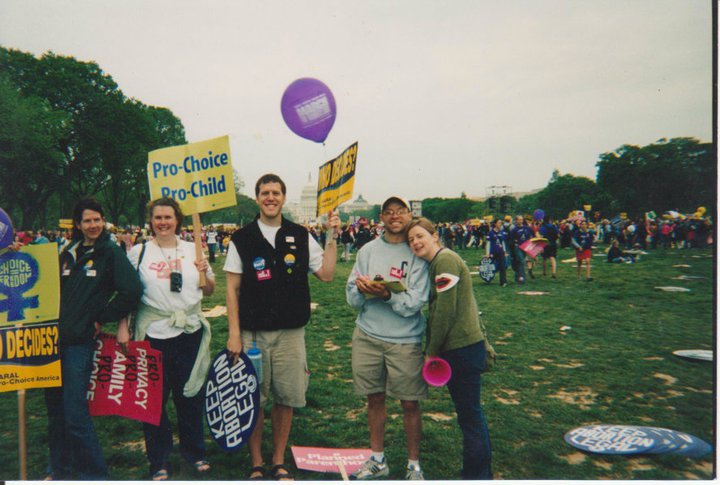
But the single greatest protest experience of my life was the 2006 March for Women in Washington, D.C. I went with a group of friends from grad school, and it was the very first night I’d spent away from Connor, who was nearly two. I have only the vaguest memory of Tina Fey and Amy Poehler and Cybill Shepherd, speaking on the National Mall, but what’s indelibly etched into my most 3D, high definition, full-sensory memory is walking down the dotted line in the middle of Pennsylvania Avenue, holding high a sign that said, “Pro-Choice, Pro-Child.” Because I was, and am, and in that electrifying moment, I was more sure of my own power and identity than I’ve ever been, before or since. I owned that street. I could change policy, I could influence outcomes, I could stand for the silent. I was mighty.

And once you’ve had that drug, once you’ve danced at the victory party, once you’ve cried as election results rolled in, you just can’t get enough of it. Currently, I’m working as a team leader in Saint Paul for Minnesotans United For All Families, the organization fighting the proposed amendment to the state constitution banning same-sex marriages. It’s going to be a lot of work between now and November, on top of the other political work I’ll no doubt take on, but I can’t imagine writing injustice into the permanent guiding principles of any state or country.

I wrestle with being the parent and the activist. My heart aches for the tiny children I see holding horrid, hateful signs they couldn’t possibly understand at funerals and Planned Parenthood locations. Sure, I gave my 2 1/2 year old a sign that read “Bush Is Scary, Vote For Kerry” at a rally in 2004. And when a MN state legislator slammed Neil Gaiman for “accepting” a 5-figure honorarium from a community library for doing a book talk and signing (“accepting” is in quotes because he turned right back around and donated it to a library support organization, as he often does), I didn’t give my family any choice about whether we’d go to the Read-In for Civility on the capitol steps. But I want them to grow up with their own priorities, their own causes, their own voices.

I want my kids to grow up thinking it’s worth the effort to stand up, be heard, and work for values they believe in. I want them to grow up knowing that it isn’t acceptable for one group to oppress another, or to silence a voice just because it disagrees with someone powerful. I want them to open their hearts, to make themselves vulnerable, by caring about the fate of humanity and the planet. If their values don’t always match mine, I’ll talk to them to find out where they’re coming from and make sure they’ve got all the information to make an educated stand, but I won’t make them back down. They have the same rights I fight to ensure for others.

And some day–maybe soon–I’ll take them shopping for their very own Protesting Boots.


BALLOONGATE!

I attended my first caucus in February; I’d only ever voted in primary states before, so I was keenly interested to see what this approach to local politics had to offer.

What did I get from it? I got elected precinct chair. I also got acute pancreatitis. (Okay, caucusing didn’t give me that–a gallbladder full of gravel did–but I was permanently scarred. No, really.)

As a result of the political events of that night, I also had a delegate’s seat at the Democratic, Farm, and Labor (DFL) party’s State Senate District Nominating Convention on Saturday. What I didn’t have on Saturday, though, was a babysitter, so with the Darling Husband guest-of-honoring it up at a convention in New York, I had convention credentials, two sons, and only one option: these poor kids were about to get a Saturday morning, non-musical lesson in civics.

I’d have just stayed home, but between the caucus and the convention, the new redistricting lines were announced. The new State Senate district boundaries put two long-time Democratic politicians up against one another, and I suddenly found myself being courted like I haven’t been since the DH slipped those emeralds on my finger in Aberdeen. Mailings, phone calls, invitations, even a house visit! I knew my vote would really count, win or lose, so ditching wasn’t an option.

Connor (L) and Griffin (R) at our little bastion of non-political entertainment at the MN DFL SD66 nominating convention. Note the balloons on the rows of seats behind them.

We went loaded for bear–computer, DVDs, iPhone, books, toys, and a host of questionably healthy snacks–and I’m going to tell you up front that the boys were outrageously, unexpectedly, refreshingly well-behaved. Really, I couldn’t expect better from any kids their age in similarly boring circumstances. About halfway through, Connor decided he was happier over by me on the convention floor. I explained what was going on, answered some of his questions, and he listened for a while. Eventually, we started playing Squares, which was far more consuming than the parliamentary maneuvers. Sadly, I did about as well as my favored candidate that day.

The different wards and precincts were arranged in rows of chairs, with balloons on the ends, marked with the appropriate numbers (we were in Ward 4 Precinct 13, so our balloon read W4P13). As with everything that requires people to sort themselves into appropriate groups, things immediately got confusing when delegates were required to take their seats. They counted off each precinct, and though the row in front of us was marked W5P3, it became apparent that no delegates from that precinct were in attendance. Connor happened to be seated in the chair to which that balloon was tied, and the woman running the convention indicated that the balloon should be taken down, to avoid any further confusion about that precinct.

I’ll let Connor take the story from here:

I asked if I could have the balloon. She said yes, but I shouldn’t take it out of the room, so it didn’t cause a fire hazard. [Mom: Balloons are fire hazards? Connor: No, it’s not; it just sets off the fire alarm. Mom: Oh. Huh.] The lady next to Mom had a Swiss army knife on her keychain, and she helped me cut it loose. 

Exhibit A: The Balloon, tied up in quarantine.

I took it over to show Griffin, when two sergeants-at-arms came over and stopped me. A nice woman said, “Don’t go out of the room with it.” I said, “I’m not going to take it out of the room.” Then she said, “Okay, but still, I don’t want you walking around with it.” Then the other sergeant-at-arms said, “Either give it to us, or pop it.” So I said, “But the people said I’m allowed to have it.” The nice lady asked, “Who were they?” I said, “They’re the people on the stage. My mom said it was okay.” Then the man said, “Are you arguing with me? Give us the balloon.” So I gave it to them. I felt very sad, like I didn’t have any power at all. And the worst part is, they didn’t do anything with the balloon! They just tied it up to a pole! 

Exhibit B: The Sergeant-at-Arms (not the nice lady, the other one)

I came over to tell Mom and the other people in her precinct. They all said that that wasn’t fair. I said this convention was ageist, and they said I should go to the microphone and ask if the DFL platform was anti-fun. I think they were joking. But Mom gave me her phone and told me to take pictures, like a reporter, and that we would tell the story on her blog. That made me feel better, because I was, like, “Now everyone will know about this! Everyone will remember this day as BALLOONGATE!”

I’m pretty sure we need a Schoolhouse Rock episode to explain this travesty of justice.

Mar 31, 2012 - Social Studies    No Comments

Guess Who’s Coming To Dinner, Part II

Last week, I started a new feature on the blog called Friday Night Lists, with the first of three lists of people I’d love to sit down with, around a dinner table, and talk the night away. Last week, I gave my picks from the pool of living participants. This week, I’d like to introduce you to my guest list drawn from all of history. Like last week, I’ll give a brief blurb about why I’ve picked each person, and I’ll provide a link, in case you’d like to learn more about the ones I’m introducing you to/reminding you of.

As with all my lists, I’ll inevitably forget someone–much footstomping and cursing will follow. So please share your picks, to help remind me in case my sons ever do manage to build a TARDIS out of a refrigerator box.

MY HISTORICAL GUESTS

  • Christine de Pizan: medieval author; philosopher. Her clever allegory City of Women books make the case for a feminist perspective on Christianity, without proposing that women’s only place in the world was as an empty vessel for children or the Holy Spirit.
  • Constance de Markievicz: politician; rebel; founder of the Fianna Eireann. She dressed like a man, sat at the table with the intellectuals who planned the 1916 Easter Rebellion, and trained the generation of boys and girls who would see through the dream of an Irish Free State.
  • Edward R. Murrow: journalist. Through the new medium of radio, Murrow brought the early days of World War II into American homes, fearlessly reporting from London throughout the Blitz, and from many other hazardous locations. As if that weren’t brave enough, he stood up to the McCarthy witch hunts in the name of free speech and accurate reporting.
  • Franklin Delano & Eleanor Roosevelt: four-term president of the United States; First Lady & activist. He engineered the New Deal and the American social safety net, then gave the nation a moral compass to get through World War II. She was a smart, welcoming First Lady, and an inspiring advocate for peace when she founded the United Nations. They weren’t perfect, but my admiration is boundless.
  • Hatshepsut: king of Ancient Egypt. She stands out as a fearless female leader in the midst of millenia of patriarchal influence. She wasn’t satisfied with the qualified, subordinate title of “queen;” she dressed and ruled like the great kings of the Nile.
  • Jim Henson: puppeteer; director; artist. Who could possibly envision everything from Sesame Street to the Skeksis, and a million sights in between? His respect for children, smart and wacky sense of humor, and gift for finding the humanity in every sock and stick was half of what defined my idea of imagination as a child.
  • John Lennon: singer/songwriter; artist; activist. Half of the greatest songwriting team of all time, he lived a second act that spread the word of love and peace, before ending far too soon.
  • Katharine Hepburn: actress; author. She was brainy, cool, elegant, funny, and smart-mouthed. I watched everything of hers I could find as a kid, much of it on the big screen, from “Kitty Foyle” to “The Philadelphia Story” to “The African Queen.” She brought immeasurable class and fearless grit to every aspect of her life. I even wear my long hair in a bun, in hopes that someday, it’ll just stay like that, just like hers.
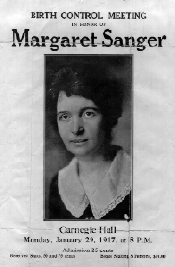
  • Margaret Sanger: nurse; midwife; sex educator; founder of Planned Parenthood. She knew that a woman’s power over her reproduction was even more important for her ultimate health, wealth, and upward mobility than suffrage. As you wonder how birth control is even a topic for debate in 2012, spare a moment for dear Margaret and the sheer will and courage it took to fight that fight in public 100 years ago.
  • Oscar Wilde: author. He skips from whimsy to horror to cutting satire so fast, it gives a reader or theatergoer whiplash. He was persecuted as a political pawn for whom he loved, and he bore the humiliation and suffering with honesty and dignity, when his opponents had none.
  • Richard Holbrooke: diplomat. It pains me that he’s not on the list of Living Guests. His knowledge of such difficult regions of the world is sorely needed, as is his skillful, sensitive hand at negotiations which ended the Bosnian conflict in peace.
  • Samuel Clemens: author. Witty, insightful, playful, and profound, Mark Twain remains my favorite author of all time, bar none. Every time I read his work, there’s a new revelation.
  • Theodor Seuss Geisel: author/illustrator. Dr. Seuss’ books shaped my childhood as much as did Jim Henson, with their psychedelic, whimsical characters and cleverly wrought language. We hardly noticed the messages of basic human rights, environmentalism, and peace, but they left their mark.
  • Thomas Jefferson: author, inventor, architect, third president of the United States. He had a completely unique view of the world, and it gave us a future we’re still unfolding. I want to compliment him on his beautiful home and garden, then grill him on his notions of “inalienable rights.”
Feb 16, 2012 - Political Science, Sex Ed    No Comments

By Any Other Name

The Rachel Maddow Show reported, on their Tuesday 14 Feb 2012 episode, about a bill recently passed by both houses of the Virginia State Legislature that would require a transvaginal ultrasound for any woman who wants to have an abortion in that state. Governor Bob McDonnell, a Republican, has said he plans to sign the bill when it arrives on his desk.

Plenty of other state legislatures have advanced measures requiring ultrasounds before a woman can obtain an abortion [1]. There is no medical function for this procedure. The logic seems to hinge on the idea that, somehow, seeing the little bean with a flickering heartbeat will convince women who haven’t fully thought through what they’re about to do to stop and treasure the full humanity of the creature growing inside them. This may well be the case for some women; for others, it’s just one more hoop that must be jumped to obtain a medical service that is both heartwrenching and necessary.

But the Virginia variant is the first of which I’ve heard that requires an ultrasound performed not by swooshing the wand around in a schmear of goo on the abdomen (transabdominal ultrasound, or TAU), but by inserting a hard plastic probe several inches into the woman’s vagina (transvaginal ultrasound, or TVU). The American College of Radiology and the Radiological Society of North America say that TVU can be useful in early pregnancy;  TVU can detect a pregnancy as early as 30 days’ gestation [2]. It’s also good for getting a better look at the uterus and ovaries [3], but a 1991 study reported that ultrasonographers gained additional information from TVU over TAU in only 35 percent of cases [4].

Ultrasound image of a first trimester fetus

Frankly, in the first trimester, there isn’t a whole lot to see, no matter how good the picture. Subjecting a woman to an ultrasound before abortion is a strategy; whether or not it is an effective one is an issue of contention. A 2009 study published in the European Journal of Contraception and Reproductive Health Care found that, when given the option, 72 percent of women chose to view the sonogram. Of those, 86 percent said it was a positive experience, but not one changed their mind about the abortion. 83 percent said that seeing the sonogram image did not make the decision any more emotionally challenging than it already was [5].

But none of these things are why Virginia legislators want the specific requirement for transvaginal ultrasound on the books, though. They want it to be intrusive. They want it to be uncomfortable. They want it to be humiliating. They want to show that the state has the power to make you submit to this penetration before you can do what you want with your body.

And there’s a name for that: Rape.

The Code of Virginia § 18.2-67.2 describes the felony of  object sexual penetration as

“…inanimate or animate object sexual penetration if he or she penetrates the labia majora or anus of a complaining witness, whether or not his or her spouse, other than for a bona fide medical purpose…and [t]he act is accomplished against the will of the complaining witness, by force, threat or intimidation of or against the complaining witness or another person….” [emphasis mine]

This is no light offense–it carries a penalty of “confinement in the state correctional facility for life or for any term not less than five years.” There’s also an interesting clause in the penal code which says that

“where the offender is more than three years older than the victim… shall include a mandatory minimum term of confinement of 25 years…where the offender is more than three years older than the victim, is for a term less than life imprisonment, the judge shall impose, in addition to any active sentence, a suspended sentence of no less than 40 years.” [6]

The Virginia law would require women to sign a consent before the ultrasound procedure, but since the state would be effectively holding the woman’s medical choice hostage to obtain that so-called “consent,” I believe there’s a strong argument to be made for coercion, which is also illegal and invalidates that consent.

Before anyone mistakes my intent, I’m not proposing that ultrasonographers should be thrown into jail for abiding by the pending bill if it’s implemented. I’m proposing that the legislators and governor who pass this law should be thrown into jail for conspiracy to commit felony rape.

Rape is psychologically devastating. It wreaks changes on a person’s life and outlook that are no less than tectonic. Survivors are simply never the same. All this, I know from personal experience. If preserving the physical, mental, and spiritual health of the woman is truly the chief concern of the legislators behind the unprecedented wave of attacks on a woman’s right to choose, they wouldn’t heap degradation, humiliation, and involuntary, unnecessary physical penetration on those women.

Unless that’s their real goal. And if that’s the case, any claim that they’re on the side of the angels should be laughed right out of the room.


[1] http://www.guttmacher.org/statecenter/spibs/spib_RFU.pdf

[2] http://www.prochoice.org/education/cme/online_cme/m4ultrasound.asp

[3] http://www.radiologyinfo.org/en/info.cfm?pg=obstetricus

[4] http://www.ncbi.nlm.nih.gov/pubmed/1785220

[5] http://www.livescience.com/12886-abortion-sonogram-research.html

[6] http://law.justia.com/codes/virginia/2006/toc1802000/18.2-67.2.html

Jan 18, 2012 - AV Club, Political Science    1 Comment

One For The Road

Websites all over the Internet are blacked out today, in protest against the proposed anti-piracy legislation making its way through the US Congress. I am not technically skilled, and while I would’ve gladly joined the protest, none of the passionate emails and postings urging folks to add their weight to the boycott actually gave instructions on how to black out your website.

But that doesn’t mean I can’t protest in my own little way. So I’m doing something that would get my site shut down, if the proponents of SOPA and PIPA have their way. It’s harmless, it’s fun, and it’s exactly the kind of free speech that these misguided bills would needlessly strangle.

THINGS YOU WON’T BE ALLOWED TO SAY ON THE INTERNET IF SOPA AND PIPA PASS

  • “I really hate those stupid Mickey Mouse homework assignments.”
  • “Say hello to my little friend…Pepe the chihuahua.”
  • “Avengers, assemble by the third floor elevator for evacuation.”
  • “I was birdwatching in the marsh, and I think I saw the first Captain Jack sparrow returning from Mexico.”
  • “I see dead people…and they look good, thanks to the fine folks at Peterson Mortuary and Funeral Home!”
  • “It’s a lovely bowl, but it was made by the most extraordinarily hairy potter you can imagine.”
  • “Luke, I am your father, not some guy off the street who you can just ign…come back here!”
  • “Th-th-th-that’s all folks! I mean it, you can’t stay here when the heat isn’t working.”
  • “The cake is a lie. All those Weight Watchers desserts are actually made of tofu.”
  • “Would you please just buzz Lightyear? I’ve been in this waiting room for 45 minutes!”
  • “Honey, you can’t keep working and cleaning and running a Girl Scout troop and volunteering at church; you’re not Wonder Woman.”
  • “The best way to get to the bridge is to go via Com…no, wait, that’s always backed up this time of day.”
  • “Grab your stopwatch, we’re going to time Warner as he says his multiplication tables!”
  • “I can’t believe how long you look in the mira, Max–you’a just some kid from Brooklyn.”
  • “Dis knee is killing me, Doc. I vish my Enklish vas better zo I could tell you.”

There. That should do the trick.

Pages:«123»