Mar 20, 2012 - Physical Ed    7 Comments

One Size Fits Most

It is, quite abruptly, spring here in Minnesota. It’s been that way for about a week now, and it’s utterly unsettling. Between the unseasonably warm weather, and the early Daylight Savings Time change, I don’t think we’ve eaten supper before 7pm in the last seven days. My boys have already collected a whole spring’s worth of scrapes and bruises–it looks like we’ve been beating them from knee to ankle.

It’s hard to complain about such beautiful weather, but I’m one of many people (especially women) for whom hot weather is an uncomfortable season to be dreaded.

See, I’m fat.

Not morbidly obese, but not just a little pudgy either. I’m tall (5’9″), but that only helps so much. I’ve got a classic hourglass figure, but they don’t really make jeans or shirts for that shape anymore. I can wear a 16, but I’m more comfortable in an 18. Most of my T-shirts are XL. My bra size is officially Not Small.

The best thing that can be said about this condition is that my kids like to snuggle with me because I’m cushy. Also, I’m perfectly healthy for my weight–blood pressure and sugars are normal. Certainly the extra weight doesn’t help my fibromyalgia, but I’ve been thinner and the pain wasn’t measurably better.

But when it gets warm, I sweat. A lot. I can’t wear a skirt comfortably without Spanx because my inner thighs get raw from chafing; along the underwire line of my bra, too. I like to swim, but between my year-long pallor and the rolls and ridges, I don’t just sit around in my swimsuit–I’m either in the water, or I’m covered up.

And then there’s the psychological side. My self-esteem has never been particularly strong. My mom used to bemoan the fact that, despite the lavish praise and compliments she used to shower on her kids, my sister and I both ended up with self-esteem as bad as hers. It wasn’t until I was 30 that I realized that it didn’t matter what she said about us–it was the fact that she never had a nice word for herself that got handed down to her children. Sexual assault didn’t help either. He was the first guy I’d ever let see my naked body. He looked, crossed the room, and turned out the light. That left a deep mark.

Sometimes, I think it’s not so bad, that I carry the extra weight well enough, that I’m pretty enough in other ways to let that slide. But what I see in the mirror doesn’t match what I see if I’m unlucky enough to get caught in a picture. Sometimes, I don’t even recognize myself–I squint at the fat person on film, until my breath catches and I realize that’s me. That my mirror is a funhouse mirror after all, but the kind that fools you into thinking things are better than they actually are.

And the culture finds all sorts of ways to remind plus-size women that they’re less than. Affordable plus-size clothes are made of cheap fabrics and rejected patterns that would never be found in the juniors or misses racks. It gets even worse if you need maternity clothes. Sure, companies like j.jill make nice, classic clothes from quality fabrics in “women’s” sizes, but they don’t carry them in stores where those women can actually try them on–we’re left with catalog roulette. And pretty lingerie? Only Frederick’s of Hollywood carries plus-size “sexy” underwear in their stores, and the fabrics are all tasteless and harsh against the skin.
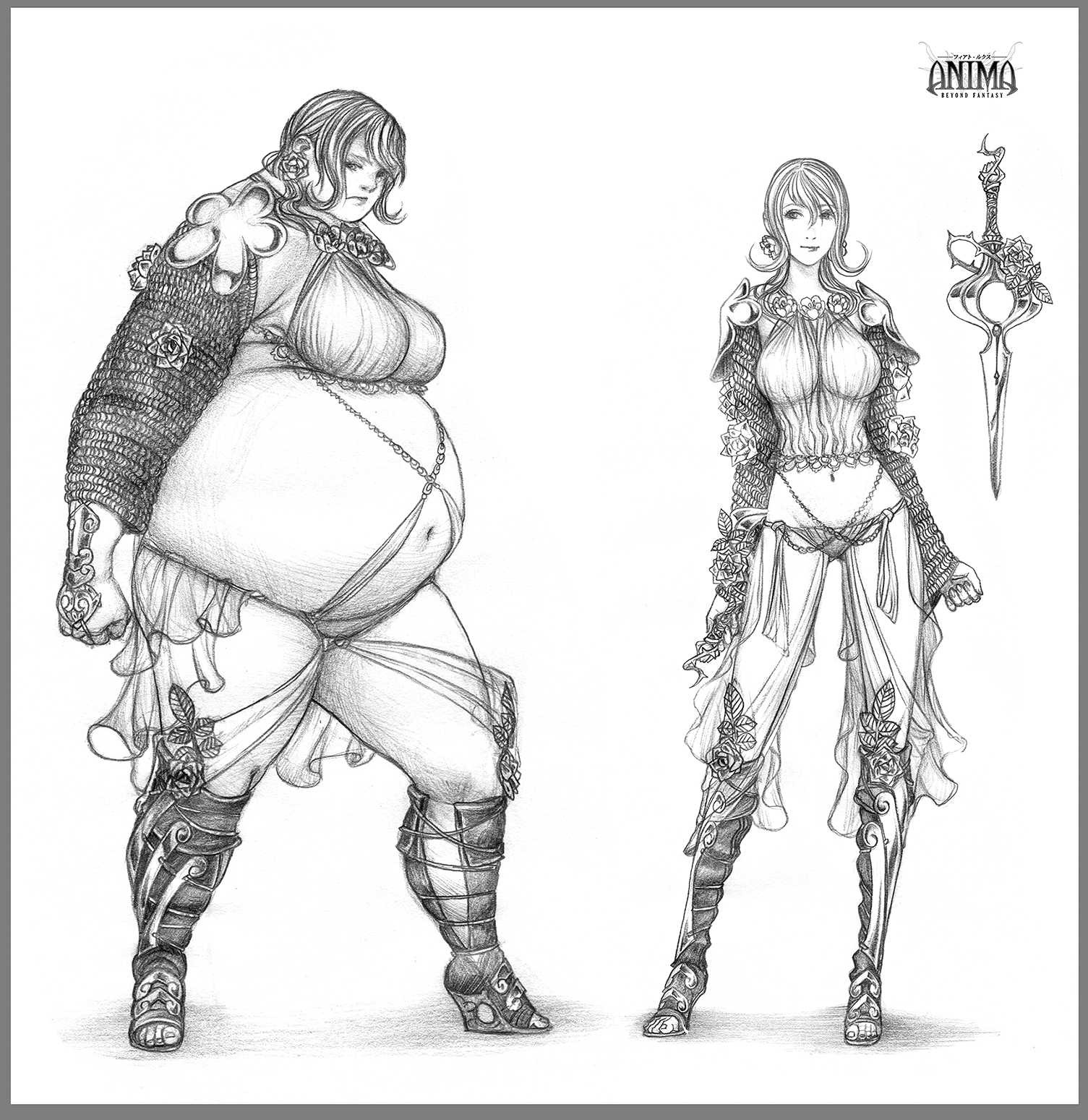
Don’t even get me started on all the other ways fat people are shamed everywhere they go. The seats in airplanes and movie theaters. Booths at restaurants. Hospital gowns. Baby Bjorns and Boppys. The mean, greedy, gluttonous fat women in movies, TV, even comic books. The stares if you dare to wear something revealing for a date, or scamper around with your kids in your swimsuit, or dare to order dessert. I’ve left the house feeling pretty and sexy and appreciated by my Darling Husband, and come home so ashamed and unattractive that I change into dumpy pajamas in the bathroom, away from even his gaze.

I enjoy the feel of sunlight and warm air on my skin. I like to run and play with my kids, on the days the fibro lets me. I like silk and linen and soft, thin cottons. I like elegant dresses and swirly skirts and pretty tops.

Courage shouldn’t be a necessary accessory. It’s almost impossible to find in my size.

Mar 17, 2012 - Ancient History    3 Comments

A Drop of the Irish

I’m five-eighths Irish, and it shows in all kinds of ways. I don’t tan–I just burn badly, then peel back to freshly-drowned white. My complexion also blushes impressively at the first whiff of emotion or alcohol. I’ve got a decisive jaw and a stubborn chin, and the attitude to back them up. I look damn fine in any and every shade of green. I’m hard-pressed to keep my toes still if there’s a spirited jig or reel playing. I’ve got a mighty temper, which rises and falls with sometimes alarming speed and whimsy. And I’ll take a chilly, misty, drizzly day–a “soft day,” to the Irish–over a cloudless 80-degree one hands down.

And oh yes: a significant number of my relatives are alcoholics.

My Grandpa Boyle, mobbed by the grandkids as usual. I'm top right; my sister lower right; 2 of many cousins on the left. Salt of the earth, my grandpa was.

Now don’t go getting on me for pandering to an ethnic stereotype. Not all Irish are drunks, probably not even a majority. But Irish social interactions have been lubricated by smoky whiskeys and beers as thick and dark as the new moon since time immemorial. (Don’t question me when use idioms like “time immemorial;” I’ve literally read the very earliest Irish historical documents.) And for so many people with Irish blood in their veins, it’s an understatement to say their relationship with alcohol is fraught with generations of experience and emotion.

And so it was with my paternal family. I’m descended from the Boyle clan, with a side order of Higgins, and I grew up in and near Milwaukee, home of the most epically huge and enthusiastic Irish Fest in North America. Holidays, christenings, birthdays, marriages, funerals, and occasional random weekends were spent in the wood-panelled basement of my grandparents’ home in a blue-collar suburb. (If you don’t know about the Irish and wood panelling, you need to pay more attention to Denis Leary.) On every available surface, there were either food or bottles of booze; with both, quantity over quality was the byword. Both were consumed at a steady pace, with the grit and determination of long-distance runners.

What I remember most about those parties–besides my cousins and slipping around on the tiled floor in my fancy shoes–was the volatility. The growing volume level, the slightly unbalanced quality to the adults’ laughter, and the overbroad, unmeasured gestures. The sudden snap of a frayed temper, the crack of an angry outburst. The atmosphere of precariously balanced danger. The longer the nights drew on, the more I instinctively shrank into myself, made myself smaller, so I wouldn’t upset the equilibrium.

My mom and father, high school sweethearts, in better days.

If it had only been at these parties, I’d probably be writing about this with more humor. But it was at home too, with no parties, no gaiety–just a staggering, slurring father, present in so many snapshots of my childhood. He worked hard, but there were weeknights he came home so hammered, he was still drunk when he walked out the front door the following morning. He’s a big man, 6 foot 4, and thickly built. Sometimes, he came home in the mood to play, but he couldn’t control his strength when he was drunk, and his horseplay often left at least one of us kids crying. Most nights though, if he didn’t just stumble into bed, he was angry and belligerent. I’m the oldest of us three siblings, so I felt it was my responsibility to protect us. We spent nervous hours crouched in the bathtub; the bathroom was the only door in the house with a lock.

My brother, sister, and I, right around the age when we all grew up very fast.

I was a pretty precocious kid, so when my mom finally demanded that he leave when I was about 8 years old, I was all for it. The next two years were hard, really hard, as my mom worked to support us on just her secretary’s salary–I shudder to think of what it would’ve been like if her parents hadn’t lived a mile away and been so generous with their time and resources. She knew the man who would become our stepdad from church–he was the Minister of Music, and she sang in the choir. She knew he’d been raised a teetotaler. Sure, he was 20 years older than her, but he’s a good man, and she knew he’d take better care of us all.

The rest of the Boyles knew my mom had given my father chance after chance after chance, but he refused to admit he had a problem, and they blamed the breakup on him. We’ve maintained very good relations with them all along, even after my father decided it was easier to think of us as dead for a while there. They supplied us with pictures of our new half-brothers from his second marriage, and they sent representatives to important events, like graduations and my wedding. I saw my father at a family reunion when I was 17. We hadn’t spoken for 8 years at that point; we wouldn’t speak again for another 17 after that.

My personal reaction to the alcoholism I saw rampant in that branch of the family tree was unusual, I guess. I decided as a child that I would never even taste alcohol until I was old enough to be sure that my personality was fully formed, and that it didn’t have addictive tendencies. Lots of my friends didn’t understand my adamant refusal to drink in a small town where drinking, having sex, and renting movies were the primary forms of entertainment, often performed in combination. But I’ve been fortunate to have a happy assortment of offbeat friends who took that quirk in stride.

I went to France my senior year of college–I would turn 21 while I was over there–and I went with the attitude that, if the occasion rose and I felt comfortable, I’d try a drink that year. But I wasn’t ready when I first got there, and the French college students just shrugged off my refusal of beer-based hospitality, and pointed me to the Coca-Cola. The real problem was with the French adults. “BWAH?!?!?” they would exclaim. “But you are in France! Everyone drinks in France! You can’t not have wine!”

Oops. Magic word: can’t. See, I’ve got this anti-authoritarian button that pops out when someone tells me I can’t, and it sounds like this: “Oh, I can’t, can I? Well, that cinches it. Just watch me.” And I didn’t drink the entire year–not on my birthday, not at any of the outrageously good meals, not in any of the charming cafés or brasseries, even though my hot chocolates and Cokes cost me 12 francs, and a beer would’ve cost me 7. That’s some fine Irish stubbornness for you there.

I had my first drink of alcohol on my wedding night, a champagne toast with my friends. The friends who’d been with me all through college and the year in France couldn’t stop exclaiming how mind-bendingly odd it was to see me drink. Some knew why I’d waited; they were happiest to see me let go of that shackle. Funnily enough, because I’d waited until I was a fully grown adult to start drinking, I’ve never been drunk. Between my Irish/German constitution, my plus-size physique, and my unwillingness to drink any alcoholic crap that comes along, getting me drunk is a damned expensive proposition, and I’d so much rather spend that money on books.

I reconnected with my father when we moved back to Wisconsin for a few years. I’m the mother of his only two biological grandchildren, and I felt it would be stingy and petty of me not to let him get to know them, and them him. He hasn’t aged particularly well, but when he grows out his beard and hair, he looks like a rather jolly Irish Santa. They send us gift cards at Christmas; I send them cards and drawings from the boys. I don’t like to think how I would’ve turned out if my mom hadn’t had the steel in her spine to leave him, and when it’s time to talk to my boys about drinking and drugs, I’ll tell them what my first 8 years were like, and why I’ve made the choices I have.

Family and history–they’re the most Irish things I have to share with them.

Mar 14, 2012 - Literature, World Religions    2 Comments

Some Facts About Fantasy

Connor, Cam, and I snuck off to see John Carter this weekend. Griffin, refusing to fall in with the family-wide cinephilia, couldn’t care less about the whole theater experience; he downright hates 3D movies–they give him horrible headaches. So we unceremoniously dumped him at a friend’s house, and the three of us reveled in two hours of pulpy fantasy goodness.

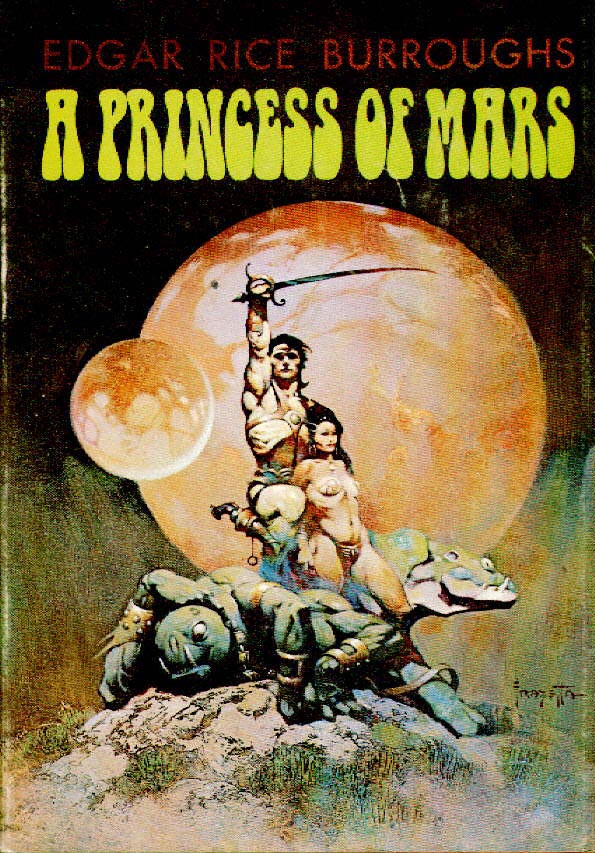
Reviewers have widely panned the movie as a “big-budget fiasco” and “the year’s first mega-disaster.” A few, like RopeOfSilicon.com’s Brad Brevet, not only took the movie at its popcorny fun face value, but also put the movie’s influences in the correct order–when the Guardian claimed that director Andrew Stanton must have pitched Disney with “Star Wars meets Avatar,” that reviewer made the same error as someone claiming that The Beatles were just rip-offs of Oasis. Brevet explains, “Throughout the history of cinema several sci-fi films have been inspired by the work of Edgar Rice Burroughs. Burroughs created the character of John Carter in 1912 and his stories have influenced a generation of filmmakers including George Lucas, James Cameron and Steven Spielberg. So if you see bits of Star WarsAvatar and Indiana Jones inside John Carter don’t be surprised.” And, as a parent, this film adaptation passes the most important test–it had Connor scouring the shelves of our local Half Price Books so he could read the Barsoom series for himself.
This certainly isn’t the first time in recent years that a book or movie seems to have gotten the short end of the critical stick, just for being science fiction or fantasy. When George R.R. Martin’s epic fantasy series A Song of Ice and Fire was adapted as an HBO miniseries last year, NYT critic Ginia Bellafante turned her nose up at “the universe of dwarfs, armor, wenches, braids, loincloth,” and suggested that “normal” women would never choose to read or watch such a series, thus triggering righteous floods of nerdrage.

Bellafante (mostly) got away with these statements because fantasy has been increasingly marginalized in Western culture since the Enlightenment, relegated primarily to juvenile literature. No, obviously I’m not saying that only children read fantasy–duh, I read fantasy, folks. But part of why adults who read fantasy find themselves as the butt of abuse or jokes is because fantasy is something society expects us to outgrow. Think about one of the most common insulting stereotypes levied at sci-fi/fantasy fans: that they never leave home, never grow up, never get out of their parents’ basement.

[WARNING: I’m about to go all pedagogical on you here. I’ll provide links where I can, but it’s not meant to be a research paper.]

The secret about fantasy that most folks don’t know is that it was the most popular form of literature for centuries before the Enlightenment. “How could that be?” you may ask. “Wasn’t the pre-modern period dominated by the Catholic Church?” Yes, but here’s the twist–the Church was the primary purveyor of fantasy literature throughout the Middle Ages. They delivered it in the form of hagiography, or the genre of writing known as Saints’ Lives. Sure, these stories of good and righteous models of Christian values were important teaching tools for Church history and theological principals to a largely illiterate population, but if it had been all morals and no miracles, medieval listeners would’ve zoned out like the rest of us do during lectures.

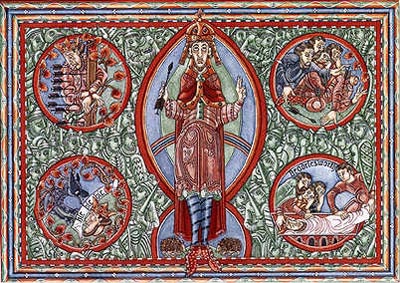
This mosaic depicts the martyrdom of St Edmund: (top L) surviving total perforation; (top R) Danes searching for the missing head; (bottom L) wolf guarding Ed's head; (bottom R) followers discover a restored and uncorrupted body upon translation of relics

Instead, Church writers folded in fantasy elements that modern readers would easily recognize: superhuman strength and endurance, monstrous beasts, mysterious lands, cosmic convergences, even the walking dead. For instance, Saints Anthony of Padua and Francis Xavier, among many others, were said to have bilocated, or appeared in two places at the same time, and Saint Collette foretold the future. When Saint Edmund was beheaded by the Danes, some versions of his Saint’s Life say that the head rolled away into the underbrush of a nearby forest, and was only found when his devoted subjects followed the howls of a wolf and found the animal calmly guarding the head from other predators. In other versions, it’s Edmund’s own decapitated body that plucks the missing head from its hiding place.

Even in this Christian icon, notice that the bowl of fire is the most prominent of Saint Brigid's symbols.

Woodcut depicting St Brendan and his companions celebrating Easter Mass on the whale's back. Yes, we now know that whales don't look like that.

Irish monks in particular, with their country’s millenia-old tradition of fantastical tales of heroes and holy men, had a knack for writing the most wildly imaginative and popular Saints’ Lives. Saint Brigit’s Life carries over many elements from the stories of the pre-Christian fire goddess of the same name, such as an unextinguishable flame at her abbey in Kildare. In tales of her auspicious youth, it’s said that Brigit’s mother had left her in a cradle at home, while she went out to gather sheep. From a distance, she saw a pillar of fire pluming through the roof of the house; panicked, she ran back, only to find the column of flame originating in baby Brigit’s crib, where the child lay happy and unharmed. Saint Brendan’s Voyages (Navigatio Sancti Brendani) included aspects of all great classical voyage literature, such as the Odyssey and the Aenaid. On his way, he encounters a sea monster, various devils, and magical animals. At one point, far out at sea, he wishes aloud that he and his companions could celebrate Easter Mass on solid land. A whale surfaced near their boat, and allowed Brendan and company to hold their services on its back.

Don’t fall for the old trope about the “Dark Ages” and how ignorant and gullible medieval people were, to believe stories like these. There were active debates about the nature of the allegory playing out in these stories, even as they were recopied and retold all across Europe. Medieval listeners could read the subtext in Saints’ Lives as easily as modern fantasy reader can pick up the underlying references and messages in Tolkien and C.S. Lewis. Hagiographers (writers of Saints’ Lives) included fantastic miracles, not just for entertainment value, but also to demonstrate an important Christian belief–that, through God, anything is possible.

As science developed and evidence-based explanations replaced the old myths and stories by which we interpreted how the world around us worked, miracles and magic gradually retreated from the realm of plausibility (though, to be completely fair, for the vast majority of the population, science was just as impenetrable a mystery as magic). Keith Thomas’ Religion and the Decline of Magic is a detailed, dense, and deeply researched guide to that transition; I can’t recommend it highly enough. Those who accepted tales of the unnatural in defiance of apparent laws of the universe were thought of as gullible, and it was assumed that only people who had no experience of the world–the uneducated lower classes and children–could appreciate or believe fantasy stories.

The need for escapism, though, never went away, and many of the greatest works of modern fantasy were written in (or in response to) periods of social tension, war, and economic hardship. We don’t believe in Edgar Rice Burroughs’ Barsoom any more than Tolkien believed in orcs, or medieval readers believed in Brendan’s sea monster. But a good story can make a bad situation better, even if only for the hours you spend in a darkened theater or sunk in a book. It’s no surprise that, following 9/11 and the economic crash, we’re suddenly awash in brilliant, compelling fantasy that both pays homage to and breaks down motifs that spring directly from pre-Christian mythology and medieval hagiography. And if it’s good for nothing more than a popcorn-munching, visually appealing (helloooo, Taylor Kitsch and Lynn Collins) brain break…well, we’re just following in our ancestors’ fantastic footsteps.


Mar 8, 2012 - Domestic Engineering    2 Comments

The Unchosen One: A Warning

If you’ve been reading this blog for even a little while, you know that family is pretty much the center of my world. You know that, most days, I may want to strangle my children, but I’d also die for them without a single thought. Most moms feel that way. It’s that whole maternal instinct thing–even animals turn ferocious when they feel their offspring are threatened. Hell, even Sarah Palin, who (at least publicly) appears to have the mothering skills of a drugged condor born in captivity, calls herself a “Mama Grizzly.”

What women don’t talk about nearly as often is the similarly violent impulse to protect a good mate, if you’re lucky enough to have one. This isn’t instinct, I don’t think; it doesn’t feel quite the same. It’s not an irresistible reflex, like hiccuping or dropping your brand new iPhone as you lunge to keep your kid from falling off his bike (admire my fancy screen crack!). This is more thoughtful, and as a result, more terrifying to witness.

Recent events have occurred in which someone made the unbelievably poor calculation to attack my Darling Husband publicly in a blog post–no, I’m not going to link it here and give it one more breath of air time–which sought to discredit the incredibly hard work he does to keep the company he works for moving forward in creative and positive ways. The first piece of miscalculation came from underestimating the vast reserves of good will the D.H. has built up in our community of friends, fans, and interested parties. The D.H. is a Good Man ™. He’s loyal to his friends, generous to fans of his work, and unfailingly polite to his critics. The most conservative of reactors to the effort to smear his work demanded names and proof; others returned the favor, retracting support and badmouthing the accuser. Needless to say, this was heartening to see.

The second miscalculation was this: He doesn’t know me. You see, if you threaten my beloved, I will end you.

It won’t be quick. It won’t happen immediately. No, I’m going to let you look over your shoulder for a while, wondering when the blade will drop. You’ll sleep with the lights on. You’ll ask others to pop corners for you, like soldiers in urban combat. You’ll question the wisdom of your actions. You may even try to walk it back, make amends. Probably cry a little, maybe publicly.

It won’t matter.

And when it does come–when I start on you–it won’t be impulsive or frantic or wild, like it would be if my children were threatened. It will be planned. It will be cold. And it will be slow. I won’t be the Mama Grizzly with you. I will be the invisible, steel-tipped ninja assassin you didn’t even know to have nightmares about.

At first, it will be utterly bloodless, just a creeping chill that prickles your hair and makes you think of ghosts. Lights will slowly extinguish around the perimeter. Birds and insects will fall to silence. Shadows will bulge and become more solid, like the meniscus atop an overfull glass. Pieces will start sliding off before you even know you’ve been cut.

When I finally let you see me, I will be smiling.

I won’t “go medieval” on you. You see, I’m actually a medievalist. I know what medieval people did to each other. Usually, it was short, brutal, and efficient. Normally, that would appeal to me–I like to be efficient. But you have filled me with wrath, and wrath isn’t interested in efficiency. Wrath is all about artistry.

You know who really did wrath? The Old Testament. No, I won’t “go medieval” on your ass–I’ll go Old Testament. The Hebrew God tells his own chosen people what he will do to them if they don’t follow the strict laws he has laid out for them in Leviticus 26:29-33:

“But if you will not listen to me and carry out all these commands, and if you reject my decrees and abhor my laws and fail to carry out all my commands and so violate my covenant, then I will do this to you: I will bring upon you sudden terror, wasting diseases and fever that will destroy your sight and drain away your life. You will plant seed in vain, because your enemies will eat it.

I will send wild animals against you, and they will rob you of your children, destroy your cattle and make you so few in number that your roads will be deserted.

And I will bring the sword upon you to avenge the breaking of the covenant. When you withdraw into your cities, I will send a plague among you, and you will be given into enemy hands.

You will eat the flesh of your sons and the flesh of your daughters. I will destroy your high places, cut down your incense altars and pile your dead bodies on the lifeless forms of your idols, and I will abhor you. I will turn your cities into ruins and lay waste your sanctuaries, and I will take no delight in the pleasing aroma of your offerings. I will lay waste the land, so that your enemies who live there will be appalled. I will scatter you among the nations and will draw out my sword and pursue you. Your land will be laid waste, and your cities will lie in ruins.”

Remember: God’s chosen people get this kind of treatment. You? I didn’t choose you. You don’t deserve that consideration. You chose my Darling Husband.

Now start running.


A Gift Better Not Given

Most days, I try not to think about how my kids were formed (note: I didn’t say “how they were made;” that was quite pleasant), just like I try not to think about how my husband and I met. The odds are just too astronomical that things worked out the way they should, and on less-good days, it’s hard to believe that the universe has even one good thing in store for me after pulling off those hat tricks.

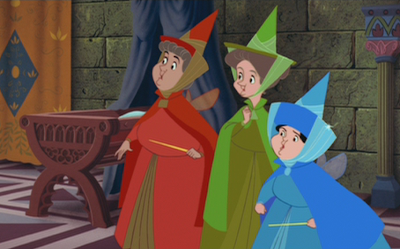
But every once in a while, especially when I see something of myself or Cam reflected back from them in flawless mirror image, my mind flits across whimsical images. Sometimes, it’s the three fairies from Sleeping Beauty, hovering over their cradles and bestowing gifts. And sometimes, more magical in its own way for being true, I imagine those tiny coded zippers–unfurling, melding pieces of each of us into someone new and unique but so familiar, then coiling again, before doing a little do-si-do and starting the whole thing over again, in the blink of an eye. Amazing, but frankly, it hurts my head a little to contemplate it all.

Of the two boys, Griffin definitely looks more like me, or more correctly, my little brother–he certainly got his uncles’ engineering skills and sheer cussedness from both sides of the family. Connor’s a bit more of a mystery–his looks are changing so much every year–but there’s definitely something of his Auntie Fi in his smile and stubborn little chin. Not to mention his big, enormous head, an inheritance from his father which I had not truly contemplated until hour three of pushing at Connor’s birth.

Personality traits are much easier to spot and attribute. Cam and I are a lot alike, and were as children, and we’d like to think we’ve had a big influence on them as they’ve grown too, so it’s no surprise that both boys are voracious readers–Connor loves adventure stories, comics, and technical manuals; Griffin is my non-fiction kid, and I think we’ve read every book about animals and weather that our local library has. They’re also imaginative storytellers, and immerse themselves in roleplay that folds together Star Wars, Indiana Jones, Doctor Who, James Bond, the Marvel and DC universes, and a host of other settings in what we affectionately call “the Connorverse.” We’re fortunate that Griffin inherited my appreciation for villains; he’s not stuck as the droid, like I always made my sister, to her everlasting bitterness. And of course, there are the senses of humor, as abundantly demonstrated in the last post; like their parents, they riff from the absurd to word play to cultural references and back to the zany again.

Other gifts are more obviously from one or the other of us. To our great relief, both boys inherited my iron stomach for travel–no Dramamine for us, we’ll be here in the back seat, reading quietly through long car trips. Their talent and enjoyment for video games, though, that’s all their dad (and uncles). Connor inherited his father’s ability to produce vast quantities of heat from an internal nuclear reactor. Griffin, much to my chagrin, seems to have inherited my anti-authoritarian streak.

But then there are the gifts that aren’t really gifts, the things that show up that fill you up with regret when they surface in your child. Cam felt horrible the day we learned that Connor needed glasses, much worse than Connor did, in fact. And the first time Connor had a stretch of insomnia, I actually apologized to him for setting that little timebomb in his DNA. The Asperger’s, too, was an unwelcome complication from me and my family, though the relief at understanding what was going on with Connor offset any grief at the diagnosis. Griffin, too, has some sensory issues in common with Connor and me, but so far, no sign of being too far off the neurotypical end of the spectrum.

This has been a weird month for our family. While we’re overjoyed at the release of Marvel Heroic Roleplaying, and the attendant acclaim and delight, even good stress can be very stressful. Then I had my sudden pancreatic mutiny that landed me unexpectedly in the hospital for almost a week, and recovering from surgery for another week after that. Whatever the combination of factors, Connor hasn’t reacted well, and the deepest stretch of depression in almost two years has laid him low. He’s so fragile and off-balance: little things he could normally roll with knock him down into the trenches, and those troughs are so much deeper and hard to escape than even the usual lows that are common among Aspies. We’ve had several violent (toward himself and objects, not anyone else) meltdowns at school, as well as a hair trigger temper toward his brother and more insomnia. Yesterday’s major event, to my furious frustration, was brought on by a teacher who didn’t follow Connor’s IEP, which lets him go to a safe place when he’s overwhelmed at school, and told him that he needed to “stop being a baby” and stay, or he would “lose privileges like free time.” He’s been to the ER twice in two weeks for evaluation.
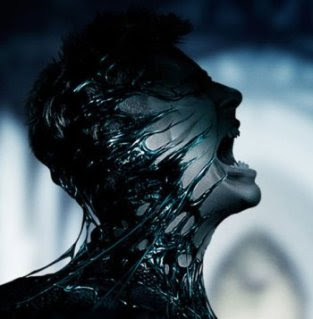
Guilt is a normal state of existence for mothers everywhere, but seeing the depression that’s derailed whole seasons of my life wrap its sticky, persistent black tendrils around my beautiful boy–it weighs like a stone on my heart. And it’s probably no consolation to him, when he says there isn’t anything good in the world for him, or anything good he can give back to the world, that I can look him straight in the eye and say, “I know exactly how you feel right now.” Sometimes, I do things that fly in the face of my own experience–I don’t particularly like or find comfort in being touched when I’m that depressed, but I hold him so tightly as he weathers hurricanes of emotion too big for his little body, and I hope it brings him calm sooner than he would find alone.

Knowing how much he’s like me in other ways is no consolation. He has my resourcefulness. He has my tendency to predict future events based on scenarios played out, like chess games, entirely in his mind. And he has my impulsiveness. Each, on their own, is harmless–even an asset in many situations. But put them together, and I’m left with the certainty that, if he decided now was the time to hurt himself, the best I could hope would be to find him in time.

The options for treating juvenile depression aren’t great, or many. We’ll step up the frequency of his visits to the therapist. We’ll work with him for plans to stay safe in every imaginable contingency; he does well with things scripted out in advance. We’ll spend a lot of time just snuggling on the couch, reading and watching TV together. We’ll work a little harder to keep him in touch with friends and family who love him so much. We’ll watch some “It Gets Better” videos. We’ll build little things for him to look forward to on the calendar for the next few months, and I’ll break myself if I have to to make sure they happen, no matter how I’m feeling.

All these plans, though, are no match for one moment of desperate action. Needless to say, I’m not sleeping much or deeply these days. I’m terrified for my baby; I would be even without any personal experience with depression. But I do have experience. When he says it’s hopeless, he’s only saying aloud something I’ve thought a million times. When he says we’d all be better off if he killed himself, he’s giving voice to a feeling etched in a dark corner of my own heart.

This broken piece of my beautiful boy comes from me. It matches a broken piece inside of me. What remains to be seen is whether my broken piece will be any help filling in the jagged edges of his tattered little soul.

Feb 27, 2012 - Domestic Engineering    5 Comments

Stop Me If You’ve Heard This One

From the way I talk about my kids here and in social media, you might think that they’re just brilliant evil madmen, whimsical annihilists, crazed Muppets on acid, determined to drive their father and me to eat, drink, and be weepy. And you wouldn’t be completely wrong.

But there’s a really important facet to them, as well, one that helps explain their continued good health:

They’re comic geniuses.

I don’t just mean that they’re funny in that old Art Linkletter/Bill Cosby “Gosh, the things kids say!” way. All kids say unintentionally hilarious things–adorable spoonerisms, mispronunciations, hilarious revelations of their skewed perspective on the world. And sure, my kids do those too–Griffin perseveres in calling his penis his “peepod,” and his pronunciation of “Dang it” as “DANIK!” But it’s more than that. In my old age, I expect to be living very comfortably on the fruits of their mega-successful comedy careers.

They’ve always been like this, too. My chief crime as a Bad Mother is that I haven’t kept a journal of all the hilarity–if it weren’t for Facebook and Twitter, even more of those moments would’ve been lost forever. When I was little and unbearably precocious, my grandma kept a stack of index cards next to her typewriter, and whenever I would say something wise or funny, she would write it down and stick it into a little binder, which she gave to me when I graduated from high school. It was such a precious, thoughtful gift, one I knew I just wasn’t the kind of person to replicate. And my memory–Swiss cheese, mesh sieve, fishnet stockings, or whatever uselessly porous metaphor you can imagine–retains only the oddest assortment of these things.

But I’m determined to convince you that these are more-than-averagely witty children. So here are a collection of my favorites.

Connor’s first celebrity crush was Jon Stewart. Yes, that Jon Stewart. We’ve had TiVo since just after he was born, and he would sit in our laps as we watched saved episodes of The Daily Show when Cam was home for lunch. Connor learned comic timing from those folks–he laughed at jokes from the rhythm, long before the words made sense to him. We hung pictures of Jon Stewart and Stephen Colbert on the bathroom wall to celebrate successful poops in the potty at least as often as we hung Lightning McQueen and Luke Skywalker. He had a little clip-on tie in his costume basket which he would affix to the collar of his t-shirts before standing tiptoe on the bathroom stool so he could stand before the mirror and rattle off little monologues in his weird moon language: “Bwuhblahbapah, hrmhuhbeda ah rmuu gagapurba… AHAHAHAHAHAHA!” Confused, we asked him, “What exactly are you doing?” He replied, all seriousness, “I Jon Stewart.” Legend has it that, at least for a while, an invitation to Connor’s Jon Stewart-themed 3rd Birthday Party hung on Stewart’s office wall.

The cake reads "The Daily Show says Happy Birthday Connor."

Griffin was born when Connor was four, and while Connor was intrigued by the strange alien parasite who’d arrived in our lives, he felt it was unfair that the rules were different for the wee beastie than they were for him. This was especially fraught at bedtime, one of which Connor had, but Griffin, as a three-month-old, avoided by sleeping any damn time he felt like it. One evening, Connor exercised his growing rhetorical skills with three award-winning attempts to get around this obstacle. From the top of the stairs, we first heard, “I think there’s someone at the door. I think it’s for me. I’d better stay downstairs in case they come back.” No. Go back to bed. Five minutes later, “It’s not healthy for me to be upstairs alone.” Ooo, nice try, kid. No. Go back to bed. Finally, the real kicker: “I think you want me upstairs because you love Griffin more than me.” Emotional manipulation–nicely played, young padawan. No. Go back to bed.

This happened to be Crazy Hair Day at school, but I have a feeling it'll be every day sooner rather than later.

Griffin’s sense of humor grew differently than Connor’s, with a definite pitch toward the absurd. He’s my angelically adorable, punk-rock, little imp of the devil. His favorite band is Green Day. He loves atomic Japanese monsters. Griff’s talent lies in the one-liner; my talent is for failing to remember them. A recent one that stuck: “Dad, the bathroom is full of zebra smell.” He’s almost shameless in his misbehavior, which yields a humor of its own–you know, the kind that also makes you reach for the Xanax. When asked if he behaved well at school, he responded with a gleeful grin, and said, “Ms. Brown said she was going to give me a color change because I was bad in the library, but by the time we got back to the classroom, she forgot, so I was good!”

Together, the two of them are overwhelming, both comically and sometimes literally. When people don’t seem to understand what raising two young sons is like, I tell them the story of the day they both had funny things to tell me at the same time. They stood directly in front of me, gesticulating wildly with their hands, as Connor said in a campy Bela Lugosi voice, “I’m an alien! I have no head! My butt is where my head should be! I have a butt for a head!” while Griffin just yelled repeatedly, over his brother’s monologue, “WAFFLES! WAFFLES! WAFFLES! WAFFLES!”

And even on the bad days, their comic genius can pull a laugh from me. Cam and I were discussing an earlier Twitter conversation about my hatred of smoothies for their frequent inclusion of unannounced secret bananas. Connor, who’d come off the school bus crying at another bad day of school, piped up, “Secret banana? Did you just say *secret banana*?”

“Yes,” I replied.

“Well, guess what? SECRET BANANA!!!” he yelled, and whipped a small notepad with a cover featuring a cartoon banana out of his jacket pocket.

How could I not laugh? I mean, honestly, what were the odds? The odds he’d have that notebook in his pocket? The odds he’d remember it was there, in all his emotional turmoil? And of course, perfect timing.

I’m not the best mom in the world, not by a long shot. I’m mercurial–little things set me off too easily, spinning toward sadness or anger–and my patience escapes me with my own kids in a way it doesn’t with anyone else. I’m bossy and authoritarian, and I try to make everything a teachable moment. And I can’t be active with them all the time, the way I’d like, the way my mom and grandma were with me–the pain and the fatigue set arbitrary limits and scuttle the best-laid plans, and I hate that they know from how I’m holding my body to ask whether I should maybe take some medicine.

But I am, and always will be, their best audience.


Feb 25, 2012 - Psychology    5 Comments

Minnesota Nice

Things you should know about me

  • I love volunteering for good causes
  • I love making people feel good about themselves
  • I love trying new things
  • I love making people laugh
  • I also use humor to defuse tense situations
  • I need to feel useful
  • I try to be honest, tactful, and polite, even when they seem mutually exclusive
  • I frequently wear myself out doing things for others before I get around to taking care of myself
  • I have an anti-authoritarian, rebellious, “Who the hell are you to tell me I can’t?” streak a mile wide
  • I’m wild about democratic politics, but not interested in small group interpersonal politics, except in an abstract, anthropological way
  • I love when my enthusiasm for something makes others enthusiastic too
  • I somehow manage to have abysmal self-esteem and a sense of unflappable calm and competence in crises
  • I probably like making lists a little too much
  • I’m pretty riled up at the moment, so this is about as passive-aggressive as I get
  • I’m pretty sure the people I’m upset with don’t read this blog

Things I don’t really enjoy

  • Power politics in places you don’t expect them
  • People who hoard information to guarantee their continued importance
  • People who let someone else take fire as a leader, but continue to pull strings behind the scenes
  • Finding out important things about an institution that radically change your understanding and expectations of what’s possible
  • The belief that intellectuals can’t possibly know anything practical about the “real world”
  • The stance that it’s not worth even trying new things because there’s the chance that they’ll fail
  • Grown-ups who still rely on status cliques for a sense of importance
  • People who won’t blow you off to your face, but who basically stopped listening before you started talking
  • Being accused of selfish motives for taking on time-consuming, thankless volunteer work
  • Finding oneself nominated by the method of everyone else taking a step backward while you stood still
  • Being my own (and only) cheerleader
  • Feeling like a project that’s meant to be helpful and positive is now nothing but a drag on time, energy, and emotional reserves
  • Working on not being such a control freak, and then watching everything go directly to hell the minute I leave it alone
  • Being hamstrung on projects that are important to me because I don’t play politics
  • The why-am-I-even-trying-anymore kind of tired

Things I actually do enjoy

  • Kids wanting to hug me, high-five me, say hi to me, tell me a joke, or ask when I’m coming back to their class, every time I walk down a school hallway
  • When good, solid, simple plans work like they’re supposed to, defying others’ expectations of failure
  • Having another project that actually is working, and doing good, and is appreciated
  • People who feel like I’m approachable and non-judgmental, even when the group I represent leaves them feeling excluded from a secret society
  • Helping friends
  • Helping kids
  • Helping strangers
  • Helping anyone, anywhere, anytime I’m asked
  • My hair color, even if I’m “too old” to be doing weird stuff like this
  • A good old-fashioned bitch session
  • People who support me when I go out on a limb with good intentions
  • Participating in conversations that have no mysterious subtexts or power dynamics I don’t know about
  • Making my own social group where the misfits feel welcome and valued
  • A level playing field
  • Offering a graceful way out of the corner someone has painted themselves into (eventually)
  • The job-well-done kind of tired

A Thousand Little Things

This is Gwen.

I’ve been working for a while now, in all my copious spare time, on organizing a fundraiser to help some dear friends. Given how closely to the bone my family lives from time to time, it may seem like an odd choice for me to use my time to make money for someone else, but my efforts aren’t about the money. The money’s just the most immediate way to begin righting a wrong.

Elizabeth and Shreyas have two daughters. Nirali is two years old and completely adorable. And Gwen is eight, whip-smart with a smile as big as the world. Gwen is also autistic. Her family has had to pull her out of the public school where she’s been going since they moved to California because of its stubborn refusal to follow the Individualized Education Program (IEP) that outlines Gwen’s difficulties, goals, and the school’s obligations to help her function at her fullest capacity. IEPs are legal documents, and the school has broken the law time and time again by refusing to provide the support Gwen needs to learn and participate.

If her family just pulls Gwen from the school, with no follow-up, there will be no record of the egregious offenses the school district has committed. Another family with their own bright, high-functioning autistic child might run into the same obstinacy and intransigence, and never know that their experience is part of a pattern that goes back years.

The only way to change things in the future is to fight now. And fighting is expensive.

In return for donations to help Gwen’s family fund the legal fight and prove that a private school can do what the public school refuses, I’m putting together six months of new short fiction from a fantastic roster of writers. Every other Monday (with occasional “freebie” days at random), subscribers will get something new to read. Readers of fantasy, sci-fi, horror, and generally offbeat stories will recognize some of the authors who’ve already committed their talents: Matt Forbeck, Kenneth Hite, Josh Robern, David Niall Wilson, Cam Banks, Steven Savile, and more. Still more authors are still stepping forward; I’m thrilled and humbled by everyone’s generosity. You can subscribe right here.

But I’m not just doing this for Gwen and her family, much as I adore them. I’m not doing this just because it’s the right thing to do, though it obviously is. I’m doing this out of gratitude for the thousand little things my sons’ school does for them, above and beyond Connor’s IEP requirements.

I’ve written before about the misunderstanding, the ignorance, and the physically and psychologically scarring bullying Connor received from both administration and classmates at the school where he attended kindergarten. His Asperger’s Syndrome was so obvious to trained observers that, when we switched him to a different school for first grade, we were called in for a meeting about his diagnosis before the first month of school was over.

Over the years, we’ve had meetings upon meetings around that packet of papers labeled “IEP.” They’re full of jargon, full of measurable annual goals, services and modifications, assistive technology considerations, and other daunting phraseology. But that jargon translates into real help that makes a real difference. It gives him permission to walk out of any situation that’s overwhelming him to the point that he feels a meltdown coming on. It gives him access to tools like fidgets and weighted vests that allow him to focus longer and be more at ease in loud, crowded situations. It justifies the time spent in social skills group and occupational therapy, when other kids are drilling on academics that Connor mastered a grade or two ago.

All those therapies and tricks and tools are incredibly helpful. But the things for which I get down on my knees in thanks, and that I wish for Gwen and every other amazing kid trying to cope in this noisy, gaudy, overwhelming world with their quirky superhuman senses, are the things that aren’t ever written into an IEP. They’re the points of human contact, of compassion from professionals whose hands are more than full with the everyday concerns of all the other “perfectly normal” kids.

It’s the way that, when Connor had a meltdown at school after a week of substitute teachers and his mom in the hospital, the principal offered him a hug, and just held him as he sobbed under the weight of emotions too big and complex for him to sort out alone.

It’s the way that the school social worker offered to use “special funds” to buy a pack of undershirts so Connor didn’t have to wear the pressure vest that helps him stay calm on the outside of his clothes, where it might be noticed and commented upon by his classmates.

It’s the way that they recognized that his need for a break in the day could be fulfilled by an activity that would raise his self-esteem and make use of his extraordinary talents, and set up a schedule to act as a “reading buddy” to second-graders who could use a little extra attention.

And it’s the way that these amazing teachers and administrators are extending the same caring resourcefulness to Griffin, who doesn’t even have an IEP, but has needed help adjusting to kindergarten. They created a “job” for him, carrying a crate of books to the nurse’s office in the morning, and back to the classroom in the afternoon, to let him feel proud of helping as he gets some much needed movement breaks. It’s the special desk they made for him, with faux fur, sandpaper, and a bumpy silicone potholder glued to the underside for him to fidget with instead of constantly touching his classmates and their work.

A thousand little things that make our kids stronger, calmer, more confident, more self-aware, and better prepared for the thousand little things that none of us can foresee from day to day. Like those waterfalls of brightly colored ten thousand origami cranes, fashioned by hand from paper and love, a labor of such dedication that it’s believed to grant the recipient one wish. Except that the visible sign of the grace and compassion of these people isn’t as perishable and impermanent as paper.

It’s the fast, bright, smart, funny, kind, curious, and beautiful boys that their actions are helping to grow. Every parent and every child deserves an education that gives results like this.

That’s why I’m fighting for Gwen.

Feb 16, 2012 - Political Science, Sex Ed    No Comments

By Any Other Name

The Rachel Maddow Show reported, on their Tuesday 14 Feb 2012 episode, about a bill recently passed by both houses of the Virginia State Legislature that would require a transvaginal ultrasound for any woman who wants to have an abortion in that state. Governor Bob McDonnell, a Republican, has said he plans to sign the bill when it arrives on his desk.

Plenty of other state legislatures have advanced measures requiring ultrasounds before a woman can obtain an abortion [1]. There is no medical function for this procedure. The logic seems to hinge on the idea that, somehow, seeing the little bean with a flickering heartbeat will convince women who haven’t fully thought through what they’re about to do to stop and treasure the full humanity of the creature growing inside them. This may well be the case for some women; for others, it’s just one more hoop that must be jumped to obtain a medical service that is both heartwrenching and necessary.

But the Virginia variant is the first of which I’ve heard that requires an ultrasound performed not by swooshing the wand around in a schmear of goo on the abdomen (transabdominal ultrasound, or TAU), but by inserting a hard plastic probe several inches into the woman’s vagina (transvaginal ultrasound, or TVU). The American College of Radiology and the Radiological Society of North America say that TVU can be useful in early pregnancy;  TVU can detect a pregnancy as early as 30 days’ gestation [2]. It’s also good for getting a better look at the uterus and ovaries [3], but a 1991 study reported that ultrasonographers gained additional information from TVU over TAU in only 35 percent of cases [4].

Ultrasound image of a first trimester fetus

Frankly, in the first trimester, there isn’t a whole lot to see, no matter how good the picture. Subjecting a woman to an ultrasound before abortion is a strategy; whether or not it is an effective one is an issue of contention. A 2009 study published in the European Journal of Contraception and Reproductive Health Care found that, when given the option, 72 percent of women chose to view the sonogram. Of those, 86 percent said it was a positive experience, but not one changed their mind about the abortion. 83 percent said that seeing the sonogram image did not make the decision any more emotionally challenging than it already was [5].

But none of these things are why Virginia legislators want the specific requirement for transvaginal ultrasound on the books, though. They want it to be intrusive. They want it to be uncomfortable. They want it to be humiliating. They want to show that the state has the power to make you submit to this penetration before you can do what you want with your body.

And there’s a name for that: Rape.

The Code of Virginia § 18.2-67.2 describes the felony of  object sexual penetration as

“…inanimate or animate object sexual penetration if he or she penetrates the labia majora or anus of a complaining witness, whether or not his or her spouse, other than for a bona fide medical purpose…and [t]he act is accomplished against the will of the complaining witness, by force, threat or intimidation of or against the complaining witness or another person….” [emphasis mine]

This is no light offense–it carries a penalty of “confinement in the state correctional facility for life or for any term not less than five years.” There’s also an interesting clause in the penal code which says that

“where the offender is more than three years older than the victim… shall include a mandatory minimum term of confinement of 25 years…where the offender is more than three years older than the victim, is for a term less than life imprisonment, the judge shall impose, in addition to any active sentence, a suspended sentence of no less than 40 years.” [6]

The Virginia law would require women to sign a consent before the ultrasound procedure, but since the state would be effectively holding the woman’s medical choice hostage to obtain that so-called “consent,” I believe there’s a strong argument to be made for coercion, which is also illegal and invalidates that consent.

Before anyone mistakes my intent, I’m not proposing that ultrasonographers should be thrown into jail for abiding by the pending bill if it’s implemented. I’m proposing that the legislators and governor who pass this law should be thrown into jail for conspiracy to commit felony rape.

Rape is psychologically devastating. It wreaks changes on a person’s life and outlook that are no less than tectonic. Survivors are simply never the same. All this, I know from personal experience. If preserving the physical, mental, and spiritual health of the woman is truly the chief concern of the legislators behind the unprecedented wave of attacks on a woman’s right to choose, they wouldn’t heap degradation, humiliation, and involuntary, unnecessary physical penetration on those women.

Unless that’s their real goal. And if that’s the case, any claim that they’re on the side of the angels should be laughed right out of the room.


[1] http://www.guttmacher.org/statecenter/spibs/spib_RFU.pdf

[2] http://www.prochoice.org/education/cme/online_cme/m4ultrasound.asp

[3] http://www.radiologyinfo.org/en/info.cfm?pg=obstetricus

[4] http://www.ncbi.nlm.nih.gov/pubmed/1785220

[5] http://www.livescience.com/12886-abortion-sonogram-research.html

[6] http://law.justia.com/codes/virginia/2006/toc1802000/18.2-67.2.html

The Censorship Quandary

The main job of parenting is to introduce your kids to the world outside your home in a way that best helps them make sense of it and learn to survive in it. You take them places, and show them things, then stand aside and anxiously watch them discover the joys and pitfalls for themselves. You clap and cheer, and dry tears and kiss scrapes. And it’s worth noting that this job isn’t only done by parents–any adult who deals with children experiences these things, and bears the honor and responsibility for those children’s formation.

The point of divergence among parents is when to expand the fence we build around our kids, to include new information and experiences. Obviously, this is a hot-button issue, laced with words like “censorship” and “age-appropriate” and “psychological trauma” that fuel an entire industry of researchers and trade paperback sales. Morals and memories of our own formative years have a powerful impact on our choices, as do our unique tastes. Sometimes, this veers in the absolute opposite direction from how we were raised. We resolve to raise our children with or without those influences: religion, politics, bad food, naughty words, even our extended family.

And sometimes, we lean into the curve of our own years, and urge our children into the shape of the things we’ve grown to love. The phrase “Where has this been all my life?!” is a strong predictor of parental behavior; the favorite shouted phrase of teenagers throughout time and space, “When I’m a parent, I’m never going to make my kid go there/eat that/do this!!” rarely factors in parenting decisions later in life. My husband and I are geeks who are making our living from an industry based on social experiences of play–it was a foregone conclusion that we would mold our little creations to share some of our offbeat enthusiasms. I showed Connor Star Wars when he was two, the same age at which I’d seen it (when it was first released in 1977), and Griffin was about the same age when I introduced him to Godzilla and all the other Japanese atomic monsters. And sure enough, they’re evolving nicely on the quick-witted, culturally referent, and wide-ranging track we set them.

But, inevitably, there are hitches in the unrolling of the tapestry of the world we lay at our children’s feet. Some, we never see coming. When Connor was born in the long, hot summer of 2002, we started watching “The Sopranos” on DVD to while away the humid evenings. He would actually stop nursing and look at the TV in recognition when the theme song came on. In large quantities, this show can have a deleterious effect on one’s language; I suddenly found myself saying, in the voice of Paulie Walnuts, “This f—ing guy!” whenever Connor would poop in a brand-new diaper. At the same time as we were awash in a stew of New Jerseyan profanity, I discovered that I no longer felt comfortable leaving live news on TV around my newborn son, a feeling that intensified as he grew to toddlerhood. I must admit, I am a news junkie; have been since high school. I mean, slap a vein and stick in a global 24-hour mainline–I want it all. So this discomfort came as a distinct shock to me as a new mother, a radical and instantaneous re-prioritization that told me I was no longer the same person I had always been, the first of many.

Other problems, we see coming and face with deep ambivalence. For instance: I swear. A lot. Not as badly as I did when I lived in France, but I’m somewhere between dockhand and a Naval officer on his ninth month at sea. I’ve tried to rein it in, but I just can’t force it entirely from my vocabulary, which will doubtless earn me the scorn of parents with more willpower. I’ve always believed in the concept that there are no bad words, only the wrong situations for them; calling them bad gives them more power, as most ably demonstrated by the Harry Potter novels. So I’m raising my kids to know that swear words are not appropriate for children, and are a reflection of strong emotions, and so far they get it. Connor, in particular, is still pained by my profanity, and regularly implores me to “be appropriate” around him, but I’m convinced he does this for the sheer joy of turning the tables on me. I’m also grappling with my awareness of the deeply bizarre American relationship with sex and violence. I’m determined not to be casual about violent themes and images, and to be less neurotic about anything to do with sex and gender, but the whole thing is fraught with conflict and difficulty. For now, I take it as a victory that my sons are some of the only young boys I know who don’t freak out at kissing or when I streak from bathroom to bedroom on the days I forget my robe.

We had a big turning point within the last week or so, with both boys. Griffin got himself suspended for a day by mooning his female classmates. When asked what on earth could’ve possessed him to do such a boneheaded thing, a thought occurred to me. Connor’s a huge fan of The Simpsons, and this was straight out of Bart’s playbook. I asked him, “Did you do it because you saw it on TV?” He nodded tearily, and mourned, “I did it so they would laugh.” So I’m having to re-evaluate the influences of tween tastes on the kindergarten set. Meanwhile, Cam has started playing Skyrim, and Connor is riveted by, of all things, the crafting. (I’m told WoW and FarmVille players will totally get the appeal.) He’s pleaded with us for permission to play on his own, so he can make leather and explore, but Cam firmly asserted that there was just too much violence and sexual content for a kid his age. I was more ambivalent, and argued that he wouldn’t necessarily even do some of the things we would be uncomfortable with, but I’m bowing to Cam’s vastly greater knowledge of video games.

It’s a comfort, though it seems wrong to put it like that, to say that some of the things that scared me the most as a child could never have been predicted, so sheltering my kids from everything isn’t going to inoculate them from every nightmare. The movie Gremlins scared the living crap out of me, and that was marketed directly at children, with tie-in toys and everything. And I was much more scared of nuclear war, as a Reaganbaby, than I was of anything I ever read–The Day After shook me so hard that it was incredibly hard to watch again as a grad student.

Similarly, one of Connor’s triggers couldn’t have been foreseen, or even insulated against. It took us a few years, until he could sufficiently articulate it, but extreme closeups of faces, especially not-completely-human faces, really freak him out. He went to see Spiderman 3–which is a horror in other ways, but I won’t get into that–at the movie theater, and none of the action or “adventure peril” bothered him at all. Instead, it was this one shot of Venom’s open mouth as he lunges at the camera that gave him fits. Likewise, there’s a scene in Fantastic 4 when Ben Grimm reveals his rocky deformation by turning his face out of shadow and lifting the brim of his hat. He leaves the room when that part of the movie is coming up, and that’s fine with me.

I console myself with the fact that we do so much with our children, and that guiding our kids through new experiences makes them less likely to be seeds of neurosis later in life. Sure, I’ve read Scary Stories to Tell in the Dark to them at Halloween–I even showed them the spooky-fantastic pictures by Stephen Gammell, which are apparently too scary to include in the latest republication. But I didn’t just give them the book and tell them to read it to themselves before bed. I was right there beside them, shivering at the gory parts and validating their fears by sharing my own. I think this prepares them for life much better than pure censorship can, and gives me the opportunity to shape their responses to their own feelings and impressions, by building a sense of empathy and honesty that I hope will serve us later when their lives get immeasurably more complex.

And if it doesn’t work, hey, I’m doing my part to support the psychoanalysts of the future.