Feb 3, 2012 - World Religions    4 Comments

The Groundhog Whisperer

Game-Of-Thrones-Groundhog-1328220980

Here is an important but little-known fact about me:

I am the Groundhog Whisperer.

No, really–I am. They come out for me, even here in groundhog-deficient Minnesota. They make themselves known. They sit up on fence posts so I can see them as I drive by. They allow me to witness their majestic gallumphing across verdant swaths of meadow and lawn. They are my totem animal, my heartbeast.

But they’re pests, you protest! They feast on my bulbs all winter, depriving me of the spring bounty I broke my back and dented my knees for in the crisp November soil! They’re just overgrown rats!

Au contraire, mes amis. Clearly, you have not considered the nobility of this wee little beastie.

He is full of dignity, though his chubby little body and stumpy legs do not speak of elegance and wit to the casual observer.


He is fierce and brave in his defense of the familial burrow.

He is tender and nurturing toward his young.

And he accurately forecasts weather, which is no mean feat.

Though I lived in Pennsylvania for ten years, I never went to the circus at Punxatawny. If it were just Phil, I’d have been there in a heartbeat.

But Groundhog Day in Punxatawny is all this:

and none of this:

But when I was in Pennsylvania, truly, every day was Groundhog Day, and not in the recursive morally didactic time loop sense (although there were days when that seemed the only logical explanation). Every time I needed to see my funny, furry friends, they were there for me. I saw a groundhog on my way to the hospital before the births of both my sons. I even saw them out of season, when any sane creature should’ve been fast asleep, which cheered me in the cold winter of depression that followed my fibromyalgia diagnosis.

And when I left Pennsylvania, they were angered.

Our friends, the Valentines, had a very nice Volkswagon Passat. It really hadn’t given them a lick of trouble, but shortly after we moved to Wisconsin, the car wouldn’t start. They took it in to the shop, where they discovered a frayed wire at the root of the problem. Wire replaced, they took the car home. A few days later, it happened again. Another frayed wire.

Curious if there were perhaps some mechanical problem involved–perhaps a belt or flywheel rubbing up against the wire–Clark cracked open the box around the engine. Nestled inside was a small family of groundhogs.

Clearly, this was a protest.

The groundhogs’ displeasure was communicated to me. Sacrifices were made, appeasements were offered, and the Great Groundhog Spirit communed with mine. And they visited their displeasure on the Valentine-mobile no more.

The goddess Brigid, in her three aspects

Next to Halloween, Groundhog Day is my favorite day of the year. It helps that it’s also adjacent to a particularly meaningful religious holiday: Imbolc, a fire feast celebrating the first point in the winter when you can appreciably notice the lengthening days. As a fire feast, it was dedicated in the British Isles to Brigid, daughter of the all-father Dagda, patroness of poets, blacksmiths, mothers, cattle, home, and hearth. When Christianity took over both the date and the goddess, it became both the Feast of St. Brigid, and Candlemas, the day on which the Catholic Church blesses all the candles to be used for liturgical purposes for the coming year. It’s a moment of brightness and optimism that buoys the spirit just before that last, long stretch to Spring.

And today was an exceptionally good Groundhog Day for me. I chaperoned a field trip for my fourth-grader’s class to hear the Minnesota Orchestra. I knew we would hear Mussorgsky’s “Pictures at an Exhibition,” which I adore–I’m rather fond of all the Russians, truth be told–but the conductor sprang a little surprise Debussy on us, which put me right over the moon (“The Submerged Cathedral,” if it matters to you). The kids were fantastically well behaved, and we were seated only about five rows from the stage, directly in front of the cellos and basses, which bathed me in glorious bass-clef sounds for over an hour. After I left the school, I went to a fancy-pants girly tea with a good friend I see too seldom, and we talked and talked and practically floated away on pots of tea.

It all felt very fitting. Just like my beloved groundhogs, I too was a dignified, cultured, well informed, free spirited creature today… all stuffed into a rather ungainly, overweight, slightly too hairy package. 

Jan 25, 2012 - Physical Ed    11 Comments

Fair Warning

I saw my psychiatrist the other day for my regular check-in. As we went over the list of meds I’m taking, both those prescribed by him and those from other doctors, I said that the anti-depressant I’m on right now is working just fine, and that the only real change since I last saw him was that my pain management docs were having me transition from narcotic pain relievers for my fibromyalgia onto tramadol, a non-narcotic.

He looked up from his notes with a sudden frown, and said, “Oh no. That’s not good.”

Since all I’ve heard from day one of being a fibromyalgia patient is that narcotics are bad, and I’m bad for taking them, and I might as well be a crack addict, his response startled me. “Why isn’t that good?” I asked.

“Have they warned you about serotonin syndrome?”
“No, I’ve never heard of it.”
“Well, it’s a fairly rare thing, but when you take more than one drug that affects your body’s serotonin level, you can get serotonin syndrome. You don’t know you have it until you become symptomatic, and once you’re symptomatic, you’ve reached the point at which there’s a 20% mortality rate.”

“My pharmacist didn’t tell me there were any contra-indications…” I began.

“Oh, no, it wouldn’t show up as a contra-indication because it doesn’t happen all the time. It’s just a possibility,” he replied.

“Yeah, but it’s a possibility that kills 20 percent of the people who get it.”

He nodded, and leaned forward to whisper, somewhat conspiratorially, “Really, the Vicodin is much safer for you to be on.”

I was stunned. Not once in the 12 years I’ve been taking various medications for my fibro and my depression has a single healthcare professional ever even mentioned the existence of this potentially fatal drug interaction.

And when I looked it up, I got even more alarmed, because you don’t even have to be that sick, or taking a bunch of medications, to find yourself at risk for serotonin syndrome. If you take any kind of SSRI or SSNRI anti-depressant or smoking cessation drug, and you take medicine for migraines (the triptans), some pain relievers, even cough syrup containing dextromethorphan, you are at risk. If you take an anti-depressant and anything else–over-the-counter or prescription, regularly or sporadically–I can’t urge you strongly enough to read up on this condition.

If the only way to know you’ve got it is to understand the symptoms when you show up, you kind of need to know the symptoms. If it’s caught early, 80 percent of those who get it survive. But if it’s left untreated for more than 48 hours, you rapidly arrive in that other 20 percent territory.

I don’t expect doctors to know every drug and every symptom and read me chapter and verse on every possible reaction to each drug alone or in conjunction. It’s not like doctors and nurses even have drug books or PDRs sitting around in their offices anymore; the Internet has pretty much put those publications out of the print business. But with drugs as common as the ones I’m talking about, and with a potential reaction with a not-inconsiderable number of deaths attributable to it, you’d think it would’ve come up with at least one of the dozen or so doctors and specialists I’ve seen over the last decade.

And it reminded me, yet again, that some doctors just don’t see a problem with withholding information from their patients. When I started grad school in 1997, I started getting absolutely blinding tension headaches. The doctor who saw me at the student health center prescribed me a tricyclic anti-depressant to manage them; it’s a not-uncommon off-label use. In the six months that followed, I put on somewhere around 45 pounds, at the same time as my husband and I went vegetarian and I was using an elliptical machine every day. I was frustrated and distraught at this inexplicable weight gain, and my self-esteem was devastated.

It wasn’t until two and a half years later when a female CRNP said, “Didn’t the doctor who prescribed it warn you that one of the most common side effects is moderate to severe weight gain?” I gritted out, “No, he most certainly did not.” She sighed sympathetically and asked, “A male doctor?” I nodded. She said, “They do that all the time. They just don’t think it’s a big deal. They don’t understand how women take that sort of thing.”

I’ve never managed to get my weight back down to where it was before I went on that medication, and that struggle takes a daily toll on my feelings toward my body, my self-worth, and my sex life. That a doctor wouldn’t think to warn me of something that major, because he didn’t “think it was a big deal,” makes my head explode. Just like it did the other day, when I was finally been warned of the risk I’ve been exposed to for so long.

I’d like to be able to just brush it off and think that it just didn’t occur to all those professionals that I’d actually be more comforted knowing all of the reasonable risks I’m incurring by following one treatment plan over another. I know it’s not the same for every patient, but it’s probably that way for more patients than they think it is. More and more, information is power, and people believe that doctors aren’t infallible and patients can’t abdicate understanding or control of their conditions.

Once again, I’m reminded and reassured that I really am my own best advocate. Sadly, what I’m most looking for in a physician these days is one who respects my knowledge of my own body, my medical history, and my research skills. It stings to pay someone with a prescription pad to just execute the treatment that I’ve found to be best. The least I can expect is fair warning if something either of us has come up with has potential side effects and risks. And when that warning isn’t given–when you discover the risks on your own or, gods forbid, through a close shave–it erodes your faith in the whole system, and every well-intentioned, well-educated professional who comes after them suffers the consequences of the mistrust that others earned.

Jan 19, 2012 - Ancient History, AV Club    2 Comments

A Magical Legacy

My grandma, Nell Kresser, in 1941

My mom’s mom would’ve been 96 years old today. Alzheimer’s claimed her in 2007, but it had stolen her away from us years before that. The gifts she gave me, though, are woven through so many facets of my everyday life and my personality that it’s almost possible to account for them all. My stubbornness, my love of teaching, my competence in emergencies, my late-night cravings for mushroom swiss hamburgers–all were etched in my soul by the strong, steady hand of Nell Kresser.

Another of her lasting legacies is my love of movies, and seeing them in movie theaters. She was passionate about cinema, and she “went to the show” at least once a week for much of her life. She was a devoutly Christian woman, so she wouldn’t brook any unnecessary profanity or dirtiness, but her tastes were broad and her appreciation infectious. She loved sweeping romantic epics like Titanic, and cute nostalgic films like My Dog Skip. She loved Disney movies; her favorite (and therefore mine) was The Jungle Book. And she cried every time she watched How Green Was My Valley.

I was an unusually mature kid, so she didn’t hesitate to bring me along when she and my grandpa went to the theater, and settling into a velvety seat beside her at Milwaukee’s great landmark theaters always made me feel so grown-up. My impression of movies evolved very differently than other kids who grew up in the ’70s and ’80s. Sure, Star Wars changed my life too–I was two years old, sitting on phone books in the front seat of our truck at a drive-in screen so big that I couldn’t tell where the starry sky of the movie stopped and the night sky above started.

The legendary Oriental Theater

But I also saw Gone With The Wind for the first time, intermission and all, at the famed Oriental Theater with my grandma. I marveled as my feet seemed to sink up to the ankle into the plush red carpet, and I was in awe of the massive golden Buddhas that lined the walls. I thrilled to the sound of Wurlitzer organ that accompanied the silent movies they screened from time to time.

I used to crane my head back to gaze up at the twinkling constellations in the ceiling of the Avalon. She took me to weeknight classic movies at the Paradise Theater, where I fell in love with All About Eve, Arsenic and Old Lace, The Philadelphia Story, and To Catch a Thief.

The Paradise Theater, now sadly defunct

These were movie palaces, in the truest sense of the word, and my grandma and I loved their hallowed halls.

I knew they were special, and I wanted to share that magic. In my high school years, I dragged friends to the Paradise for their midnight movies: the Director’s Cut of Blade RunnerThe Wall in six-track Dolby Surround sound. I saw Alien for the first time there, in 70mm–the film itself is about two inches wide, and the theater had to crank back the curtains all the way on the projection screen. Saturday night concerts meant an excuse to head over to the Oriental for their legendary midnight showings of Rocky Horror Picture Show. Those same plush carpets now softened my landings as I jumped to the left during the “Time Warp,” and I was surely the only teenager who carefully picked up every piece of toast or playing card I’d thrown from the floors of that beloved sanctuary.

And now I’m the grown-up, nurturing my own little movie buff. Connor’s been movie mad since his earliest days; he was only two when I first took him to the theater, and he sat still and quiet for maybe the first time in his life as Curious George unspooled in the projection room above us. Many autistic kids have difficulty with the overwhelming sensory experience that theater movies provide, but Connor just dives into it and lets himself be swept up in the darkness and loudness and the amazingness, like I used to and still do.

It’s not a cheap proposition to take a family of four to the movies these days, so we usually tie new releases to special occasions; movie release calendars are scrutinized for the best “birthday movie” months in advance. But we discovered the heir to the Paradise right over in Minneapolis. The Riverview Theater screens movies a month or two after their major theater release dates, which allows them to charge only $2 for matinees and kids; it’s only $3 for adults in primetime, so even date nights are suddenly affordable. Now movies aren’t just an extravagance; they’re a very affordable indulgence, and Connor and I pay homage as often as we can.

As we sat in the dark auditorium on Monday, so crowded with families taking advantage of the holiday to enjoy a weekday matinee of Happy Feet Two, I found myself watching Connor more than the movie. His eyes were huge as he followed every tiny movement on the screen; his mouth smiled, grinned, gaped at each revelation. About 20 minutes in, he started worming his way under my arm, so I flipped up the arm that separated our seats so we could snuggle more comfortably. And we stayed like that for the rest of the movie, mom and son sharing a story with each other, and the other viewers we could hear but not see around us.

It wasn’t a bad movie, but it wasn’t spectacular–Tintin, which we had splurged as a family to see at the local AMC on Saturday, had sated our need for amazing cinematic experiences quite well. But it didn’t have to be spectacular to be magical, the way every movie is to movie lovers. And as I watched the movie, and watched my son, I had one of those moments when I felt so close to my grandma again. I miss her, but I can feel her sitting beside us, just enjoying the show.

Jan 18, 2012 - AV Club, Political Science    1 Comment

One For The Road

Websites all over the Internet are blacked out today, in protest against the proposed anti-piracy legislation making its way through the US Congress. I am not technically skilled, and while I would’ve gladly joined the protest, none of the passionate emails and postings urging folks to add their weight to the boycott actually gave instructions on how to black out your website.

But that doesn’t mean I can’t protest in my own little way. So I’m doing something that would get my site shut down, if the proponents of SOPA and PIPA have their way. It’s harmless, it’s fun, and it’s exactly the kind of free speech that these misguided bills would needlessly strangle.

THINGS YOU WON’T BE ALLOWED TO SAY ON THE INTERNET IF SOPA AND PIPA PASS

  • “I really hate those stupid Mickey Mouse homework assignments.”
  • “Say hello to my little friend…Pepe the chihuahua.”
  • “Avengers, assemble by the third floor elevator for evacuation.”
  • “I was birdwatching in the marsh, and I think I saw the first Captain Jack sparrow returning from Mexico.”
  • “I see dead people…and they look good, thanks to the fine folks at Peterson Mortuary and Funeral Home!”
  • “It’s a lovely bowl, but it was made by the most extraordinarily hairy potter you can imagine.”
  • “Luke, I am your father, not some guy off the street who you can just ign…come back here!”
  • “Th-th-th-that’s all folks! I mean it, you can’t stay here when the heat isn’t working.”
  • “The cake is a lie. All those Weight Watchers desserts are actually made of tofu.”
  • “Would you please just buzz Lightyear? I’ve been in this waiting room for 45 minutes!”
  • “Honey, you can’t keep working and cleaning and running a Girl Scout troop and volunteering at church; you’re not Wonder Woman.”
  • “The best way to get to the bridge is to go via Com…no, wait, that’s always backed up this time of day.”
  • “Grab your stopwatch, we’re going to time Warner as he says his multiplication tables!”
  • “I can’t believe how long you look in the mira, Max–you’a just some kid from Brooklyn.”
  • “Dis knee is killing me, Doc. I vish my Enklish vas better zo I could tell you.”

There. That should do the trick.

Jan 16, 2012 - Game Theory    No Comments

Spoiled Rotten: Reverb Gamers #13

REVERB GAMERS 2012, #13: Who’s the best GM/storyteller/party leader you’ve ever had? What made him/her so great? (Courtesy of Atlas Games.)

I have been so ridiculously, stupidly fortunate in my gaming experiences, it isn’t even fair for anyone to take my idea of a good GM into account. Why do I say that?

I’ve been in the wild and woolly adventures of the Thorne Family in a Warhammer Fantasy Roleplay campaign run by bestselling author Jim Butcher; it goes without saying that he’s a master of epic storytelling, but he also makes every player feel important. I’ve been in an Amber throne war run by Fred Hicks, co-founder of Evil Hat; he’s got a keen understanding of character motivations, and he knows just when to twist the knife. I was at the first meeting of the Diogenes Club run by Rob Donoghue, fellow Evil Hat founder and one of the creators of Spirit of the Century; if you like bombast, wild theatrical play, and devlishly clever twists, look no further. I’ve played Roman Empire intrigues run by Jason Roberts and Michael Miller, creators of FVLMINATA; Jason’s historical knowledge is vast, even by my standards, and Mike is very skillful at breathing life into the setting. I’ve played in battles on the Caribbean seas run by Jason Hawkins, creator of Run Out the Guns! (as I’ve described elsewhere). I’ve played in a Black Company escapade run by Lydia Leong of Ars Magica and MU* fame; her technical mastery of systems frees the players to be as twinky as they want to be, yet she loves to orchestrate big fights and wallpaper-chewing RP. I’ve played in a power struggle for control of the Kansas City Camarilla run by Allan Grohe of Greyhawk and Chaosium Press renown; he’s got an unparalleled knack for balancing the egos and motives of both players and characters. I’ve played in Clark Valentine‘s original setting; Clark’s a wonder of creativity, and he thrives on player collaboration to build marvelous worlds. And, of course, I’ve played Dragonlance with Cam Banks, as well as countless one-shots and other campaigns of his design.

I’ll give all you RPG players just a moment to seethe with envy.

Some of this luck has been self-made. Several of my favorite games were run by the creators of that system and/or setting, so here’s my best piece of advice: When you’re searching convention programs for games of interest, look for the events where writers and designers are running their own games. In almost everything else, familiarity breeds contempt; in GMing, familiarity breeds comfort and flexibility.

Our Dragonlance campaign group in PA (L to R): Clark Valentine, Cam Banks, Paul Marcinkevage, Scott Williams, and Amanda Valentine. I'm behind the camera, where I belong.

Of all these extraordinary experiences, though, the best GM I’ve ever played with is, hands down, my Darling Husband, Cam Banks. Sure, I’m biased, but I think I’d get a fair amount of agreement for anyone else who’s been lucky enough to sit across the table when he’s running the show.

But I’ve got lots of good reasons why this is the case. First, he tends to run systems that he knows backward and forward, so he navigates the rules with speed and deftness. I know the look in his eyes when he’s crunching numbers, rules, exceptions, and sources; it’s similar to the look WALL-E gets when he’s making one of those tidy little trash cubes.

Here's that stat block you wanted.

Because he’s so facile with the mechanics, he rolls easily with whatever harebrained schemes his players develop (and by players doing harebrained things, I mean me, doing what I usually do). He also often runs games in settings on which he’s exhaustively informed, whether because they’re of his own design, or they’re from canons of work on which he’s earned his status as an authority, like Dragonlance and the Marvel Universe.

Second, he juggles player dynamics with uncommon sensitivity. This may be his counselling training and skills as an arbitrator showing through, but whatever it is, he’s got a knack for keeping all the characters in the mix, so even cut-away scenes when the party splits up don’t end up with anyone feeling bored, ignored, or slighted. He manages all different kinds of players and lets them play the way that’s fun for them, making the most of their strengths so that something that may seem annoying to different-style players under another GM ends up feeling like an essential contribution to the whole group.

Third, finally, and most important, he is the single most brilliantly creative storyteller I’ve ever known. He has a Red Phone with a direct line to the Primal Well of Story. If most people were put into a room with paper and pen and told to come up with as many completely original story concepts as possible in one hour, we would probably be quite pleased with two or three solid ideas–Cam would have ten, unique, insanely clever, out-of-the-ballpark hits. He sees stories the way Grand Masters see a chess game, infinite possibilities spooling out from every decision point. And despite this mind-boggling talent, he’s never threatened by his players’ input. I commit the most egregious mutilations of his best intentions, and over and over, he’s taken those derailments and woven narratives I could never have imagined. He even makes me, and all his players, feel like they’re brilliant for those contributions.

He runs games at conventions all the time, so it’s always worth trying to get in to one of his sessions. Bribe, beg, connive, steal–whatever it takes. He’ll redefine your image of a great GM, but even more remarkable, he’ll make you feel like you’re a great player.

Jan 15, 2012 - Game Theory, Literature    1 Comment

Straight Into Hell: Reverb Gamers #9 & 10

REVERB GAMERS 2012, #9: Have you ever played a character of the opposite sex? Why or why not? If yes, how did the other players react? (Courtesy of Atlas Games.)

I can only think of two male characters that I created and played–I’m sure I’ve played male pregens at cons over the years, but they don’t stick in my memory so much. The first was the aforementioned Wasabi Delmonico, the San Francisco Kid. He was for a pulp one-shot, a Chinese-American teenager who raced soapbox derby carts down the Bay Area hills and did other sorts of wacky stunts. I think we fought flying gorilla men. His name is clearly the most memorable thing about him; his gender wasn’t really a factor in the game.

Scottish pirates, burying William Kidd's treasure.The second male character I played was in a con game, but he’s lodged in my memory (and possibly those of other players) as firmly as any character in an extended campaign. My friends Lydia and Rob had raved about the fantastic sessions of Run Out the Guns! they’d played at Gen Con the year before, run by the game’s creator and historical-replica sailor Jason Hawkins. There’s a big focus on historicity and realism, for all that it’s a swashbuckling adventure game, so I didn’t want to introduce the anachronism of a female sailor, or deal with all the actual prejudice and liabilities that would come with portraying a woman accurately in the setting.

So I made a bosun’s mate named Hamish Macbeth, a brawny ginger Scot. I was thoroughly immersed in the BBC series based on the M.C. Beaton books at the time, so sue me for unoriginality if you must. I’m a pretty fine vocal mimic, so that same immersion meant that I could affect a mighty strong (and fairly accurate, if I do say so myself) Highland accent. Jason was an amazing GM–his extensive work on the Rolemaster system meant he could handle the technical aspects with a facility not associated with Rolemaster, and his deep knowledge of the setting and ships meant he made very complex things run with a wild, fly-by-the-seat-of-your-pants, theatrical ease. The ship battles were epic, and it’s a bosun’s mate’s job to relay orders from the captain to the crew. I did this in a salty, broguey bellow that was, upon reflection, completely inconsiderate to every other game going on in the labyrinthine basement of Milwaukee’s Mecca Center. But, great good gods, did we have fun.

When the game was over, Jason shook my hand heartily and said, “Hamish, man, I’d follow you straight into hell with that voice!” I’ve shared that compliment often over the years, as one of the highlights of my game convention experience, but only upon thinking of my answer to this prompt did it occur to me that Jason and my fellow players referred to me and called for my attention all that night with male pronouns and epithets. I was so deeply into Hamish’s head that I honestly didn’t notice.

I’m not usually so thoroughly sunk in a character that I forget I’m not him/her, and the dissonance between my feminine self and a masculine character when I’m not completely in either world is the reason I don’t play male characters more often. I can’t possibly know what it’s like to be inside a man’s head, and I wouldn’t dare to suggest that I do, so I don’t trust myself to accurately portray a man’s motivations as I make decisions for that character. I think most game settings and GMs go out of their way to allow for greater gender balance than strictly historical mores would accommodate, so I haven’t felt restricted in my character choices by sticking with the gender I know.

REVERB GAMERS 2012, #10: Have you ever played a character originally from a book/TV/movie? How did the character change from the original as you played? If not, who would you most like to play? (Courtesy of Atlas Games.)

I’ve played a lot of great characters from book, TV, and movie settings I love, but for this prompt, all I can think about are the ones I despise. I’m going to bring some flak from earnest fans, but here’s the honest truth:

I HATE Sand from The Chronicles of Amber and Goldmoon from Dragonlance.

For those not familiar with these characters, here’s a bit of background. The Wikipedia entry for Sand and her brother Delwin, introduced in Blood of Amber, says this: “Delwin (brown & black) and Sand (pale tan & dark brown), twin brother and sister. They only lived a short time in Amber, preferring to live in the Shadow worlds and keep themselves removed from the affairs of their siblings.” I think it was the Diceless RPG by Erick Wujcik that introduced the idea that Sand has power over the dreams of others, but I’m not entirely certain of this. In any case, she’s a minor character, and she’s as flat and colorless as the substance for which she’s named.

And I’ve never played Goldmoon in a run-through of the Dragonlance adventures that didn’t make me wonder why Goldmoon and Riverwind didn’t take their toy and go home. In one particularly memorable campaign, Goldmoon met the rest of the companions as they punched Flint repeatedly, in an effort to render him senseless so they could cross the river. I’ve got lots of problems with the character, but frankly, I’ve never been able to get past that first, most essential obstacle.

The cruelest thing my Darling Husband has ever done to me was to make me play Goldmoon in a Dragonlance one-shot while we were hanging out with friends in New Zealand. Halfway through the game, all the characters “woke up” to discover that they were actually Amberites, being manipulated through their dreams. And Goldmoon was actually Sand.

At which point, the words “divorce” and “green card” and “one-way ticket home” were casually thrown into the conversation.

Ironically, though Cam writes RPGs for licensed properties, I’ve only played Smallville once; I’ve never had the chance to play Serenity, Supernatural, Demon Hunters, Leverage, or Marvel Heroic Roleplaying. This isn’t because I wouldn’t love to. Rather, it’s a function of not being able to afford babysitters for game nights, and game conventions being work rather than play for us, on the rare occasions in the last decade when we can arrange someone to stay with the boys so I can attend. Hopefully, that’ll change, and I can finally find out what all the buzz is about.

Necessary Things: Reverb Gamers #7 & 8

REVERB GAMERS 2012, #7: How do you pick names for your characters? (Courtesy of Atlas Games.)

I’m influenced quite a bit by the setting–if there’s a clear analog to a time period or ethnic culture, I like to find a name that fits in the landscape. Just Google “baby names” and you’ll find all sorts of fantastic lists, often with meanings attached; www.babyhold.com has one of my favorites, with lots of ethnic names to choose from. I also read a lot, and books are fantastic sources of names. You might even keep a list of your own, with your gaming supplies, so you can remember the nifty names you come across in odd places. I’ve been inspired by names I found in alumni mailings, historical documents, garden centers, news reports, even on menus (I once had a pulp character named Wasabi Delmonico, after a steak description at a trendy bar and grill!).

And in case you’re the kind who does keep lists, here’s an incomplete list of character names I’ve used over the years (in no particular order): Selwyn, Rebekah, Julia, Rosemary, Margaret (aka Maggie the Book), Caledonia (Callie, for short), Bethan, Mercia, Anthea, Amara, Constance, Helga (the Wonder Nurse), Astrid, Marilla, Serafina, Lysimachia (Lysa for short; it’s the Latin name for Loosestrife, which is awesome for a fairy name), Stella Cordaric, Twink (the halfling barbarian with a soup pot for a helmet), and Freya. I know I’ll kick myself for the ones I’m forgetting, but if any of you dear readers can remember other characters I’ve played over the years, feel free to post names in comments!

REVERB GAMERS 2012, #8: What’s the one gaming accessory (lucky dice, soundtrack, etc.) you just can’t do without? Why? (Courtesy of Atlas Games.)

I’m terrible at sitting still; I have Busy Hands ™. So my essential gaming accessory is a craft to work on while the game’s in progress. Over the years, I’ve crocheted, knitted, cross-stitched, and made jewelry at the gaming table; I do this while visiting, watching movies, even during church services (thank the gods for circular bamboo knitting needles; no danger of a mortifying clatter when you accidentally drop your knitting). This is what I’m working on at the moment; you can see examples of my jewelry here.

Some people–even other women–this takes aback. From the reactions I’ve gotten from some men at convention games as I took out my tools and fibers, you’d think I’d just whipped out a breast instead. Somehow, it seems, my crafting was an unwanted feminine intrusion into their macho adventure space. In other groups, it was the norm. The battlemat was littered with scraps of embroidery floss, yarn ends, wire snippings, and stray seed beads. All the women around the table were industriously working away on their blankets, quilts, or wall hangings, stopping only to roll a handful of dice and briskly announce, “I kill it.” It was like the awesomest kind of quilting bee-slash-special forces raid.

I know that not everyone can deal with someone efficiently multi-tasking in their presence; it looks to them like I’m not paying attention as they play their part of the scene. What I try to make them understand is that I’m actually far less likely to stay focused on the action if my hands are busy. That physical occupation calms the restless, seeking portion of my mind, allowing the creative part to fully concentrate in the mental task at hand. I’d be curious to know how many other gamers on the ASD spectrum function better while stimming. I’m fortunate that my stim of choice masks what it’s doing for me in a sensory capacity. And when I’m done stimming, I have pretty things to show for it.

Jan 13, 2012 - Psychology    4 Comments

So Very Proud

Initially, I wrote this post as a note on Facebook last June, but I’m moved to repost it here. It’s been a hard week for a friend and her autistic daughter, as they struggle with a school that won’t give her what’s needed or even what’s right. It’s so hard to be a parent to these children and feel like we have anything close to what they demand, day in and day out. Every once in a while, though, you get a dividend, and somehow, other parents’ dividends show up in our paychecks too. So here’s mine, for you all, today.

Connor (in the tie-dyed shirt) leading our church group in the Twin Cities Pride parade, June 2011

Connor, Griffin, and I walked in the Twin Cities Pride Parade on Sunday, under the banner of our wonderful, inclusive church family (White Bear Unitarian Universalist Church). I hadn’t realized that the Pride Festival was the same weekend as Origins Game Fair, so doing it as a single mom of two rambunctious boys had not been in my original plan, and to say I was apprehensive would be a serious understatement.

Already, the trials of single parenting had affected my commitment to volunteer for OutFront MN, when my wonderful friend and neighbor who’d planned to take the boys Friday night called a few hours before my scheduled shift to say her daughter had been sent home from day care with nits. The OutFront folks were very understanding, and I spent some compassion capital on making dinner for all of us to share on a picnic bench outside.

But I knew the parade and festival would be unlike anything any of us had ever done, and I prepared as best I could: lots of snacks, sunscreen, water bottles, first aid kit–you know how it is with boys.  We parked near the beginning of the parade (in retrospect, a big mistake, so noted for next year), and met our co-marchers. Our ranks were swelled by members of another UU church (with drums!), and we took our place behind a paramedic crew on their ambulance.

We left about 100 ft. between ourselves and the ambulance, in hopes of avoiding the exhaust fumes, but I told Connor and another 9-year-old, Diana, that they could use the space so long as they danced and rode Diana’s adorably-decorated scooter to put on a show.

This was the order Connor has been waiting for his entire life.

For the next two miles or so, Connor danced with streamers and beads. He breakdanced (well, sort of). He did fake kung-fu. He swooped like an airplane from one side of the street to the other and back again. He gave high fives and tousled little kids’ hair among the spectators. He was the one thing he has ever wanted to be–the absolute center of attention. And the crowd LOVED HIM.

Asperger’s kids have to work so hard, all the time, to make themselves and their feelings smaller, to contain themselves to conform to societal norms. I’m not proud to say that, most of the time we’re in public, I live in fear of mortification at the next boundary he violates. For him and for me, it’s a constant strain to color inside the lines, and opportunities to say, “Go, be entirely yourself, all the way, as big as you want,” are vanishingly rare. But this parade was just that opportunity, and it was a joy to unhook the leash and set him free.

Any other kid would’ve been too embarrassed to try new moves on such a stage, or to dive into a crowd of raucous strangers demanding high fives–awareness of those social boundaries would tell us to rein it in, to tone it down, to contain the joy to just smiling big and waving. Griffin was shy for most of the parade (or intent on scouring the ground for candy). But Connor was absolutely free.

I don’t know if either of my kids is gay; I don’t care in the slightest. But Pride celebrates being your fullest, truest self, without fear or judgment, and the parade gave Connor the chance to do just that, and by doing so, he gave so many other people such immense joy. I was watching the crowd’s reaction to him–they weren’t laughing at him, they were just delighted by him, exactly as he was. And my heart felt so huge in my chest, so full it choked me with tears at times. He was free of constraint, and I was free of fear. We were both so very, very proud.

Jan 10, 2012 - Game Theory    4 Comments

Now With Extra Pulp: Reverb Gamers #6

REVERB GAMERS 2012, #6: Describe your all-time favorite character to play. What was it about him/her/it that you enjoyed so much? (Courtesy of Atlas Games)

I am terrible at picking favorites. That may make me a better mom, but it makes me a terrible blogger, and at the moment, it makes me an especially behind-in-posts blogger. I’ve been positively paralyzed with indecision for days now over this question, and there’s no way I’m ever going to be able to settle on a single favorite, so I’ll just write about two characters I enjoyed immensely.

The USO dance from "Memphis Belle."

Little known fact about me: if I could go back in time for one night to any period of history, I would go back to 1942 for a USO dance. (No, not the Middle Ages; I know so much about them that I’m quite sure I would be miserable back then.) I love the ’30s and ’40s–the fashion, the movies, the music, the architecture, and the general sensibility. Sure, I’d ditch the sexism and racism, and I know from direct testimony that the Great Depression sucked immeasurable ass; I’m not wishing things could be exactly like that again now, like some weirdly myopic nostalgic folks do. But I’d give a lot to check my hairpins and Max Factor red lipstick, straighten my stocking seams, and go swing dancing in an airplane hangar for one night (preferably with Capt. Jack Harkness, but I’m not picky).

As I’ve mentioned before, I also really love theatrical, over-the-top, seat-of-the-pants adventure roleplaying, and when pulp action games are at their best, that’s exactly what you get. So when the Darling Husband announced his plans to run some pulpy goodness using his own house system, I was all in.

My character was mild-mannered housewife Rosemary Rogers. But at night (you knew it was coming), she became a masked vigilante, determined to rid the streets of crime. She was…

The Cleaner!

No, this isn't The Cleaner, but it's in the ballpark.

Yes, with her matched shotguns Spic & Span, she patrolled the streets on her trusty Rinse Cycle, red raincoat snapping smartly behind her as she scoured New York City!

And she did kick unholy amounts of ass.

I don’t remember a lot of specific events, to be perfectly honest. She did fly a plane (or was it a pterodactyl?) through the window of a museum to escape some thugs, long before Ben Stiller did. And we had many fine confrontations with Mexican badguy El Suerte (later revealed to be criminal mastermind El Muerte) and his stubbly henchmen, led by the mountainous luchador El Toro.

If this all sounds terribly cheesy, you’re absolutely correct. That was the point. The puns, the one-liners, the ridiculous stunts–the only thing we didn’t have were giant primary-color speech balloons reading “POW!” and “BAM!” There was no deep angst, there were no wrenching decisions, there wasn’t even any meaningful character development. I’m not saying that those things don’t happen in good pulp/noir fiction or games; I’m just saying that we weren’t in the game for that. Personally, I was in it for the moments when I described the most outrageous, over-the-top stunt I could think of, earning a squint from Cam and, in a highly dubious tone of voice, these words: “Roll it.”

And somehow, far more often than probability math supports, I did.

I played in other fantastically fun pulp games over the years, most notably a one-shot of Silver Age Sentinels on one of our trips to California, in which I played a Judy Holliday-style ditzy blonde bombshell, exposed to an atomic test while visiting the troops in the Pacific, leaving her with flight and light powers. I called her The Hollywood Starlet, and I chewed gum and talked like Marisa Tomei does in “My Cousin Vinny.” While I did a number of heroic things in the game, I best remember tormenting Fred Hicks’ inscrutable Atlantean character Deep Blue by asking repeatedly, in that squeaky Brooklyn accent, “Deep blue what?!”

None of these characters are worth more than a few panels in a yellowed comic book, but for sheer untroubled fun, it doesn’t get much better.

Game On: Reverb Gamers 2012 #3, 4, & 5

Ironically, catching up with work at Atlas Games has put me behind on Atlas Games’ blog project, Reverb Gamers. But it’s a quiet afternoon at work, with no big restocking orders today and my bosses home with sick twins, I’m taking a moment to get up to date.

REVERB GAMERS 2012, #3: What kind of gamer are you? Rules Lawyer, Munchkin/Power Gamer, Lurker, Storyteller/Method Actor, or something else? (Search “types of gamer” for more ideas!) How does this affect the kinds of games you play? For example, maybe you prefer crunchy rules-heavy systems to more theatrical rules-light ones.

This question refers to basic archetypes offered by game designer extraordinaire Robin Laws. If you’re not familiar these terms, he says most players fall into one of five categories, as summarized in an excellent blog post:

  • The Power Gamer: Get more powers and use them often and efficiently.
  • The Butt-Kicker: Enjoys combat and pwning NPCs!
  • The Tactician: Like to beat complex situations through thought and planning.
  • The Specialist: The one who plays a <insert character type here>. Ninjas and Drizzt clones are popular.
  • The Method Actor: Likes total immersion in a character’s assumed persona, whatever the costs!
  • The Storyteller: Enjoys exploring a story unfold around a character’s actions and choices.
  • The Casual Gamer: Shows up to be with friends and share the social energies of the group.

(These are also the character types in the fantastically entertaining movie The Gamers: Dorkness Rising.)  Of those, I’m clearly The Storyteller: I love telling stories with my friends around characters. I explained this more fully a little earlier.

But I’m quite taken at the moment with a different set of classifications, offered by my dear friend Rob Donoghue:

  • The Connector: Plays for story; rules are of negligible importance.
  • The Evil Muppet: Creative, whimsical, engaged, and in it for a specific kind of interaction: he wants the GM to bring the pain.
  • The Swooshy Giant Brain: Super-smart, but mostly just wants to stab things for fun.
  • The Rookie: Enthusiastic, rules savvy, in it for fun, but with not as much experience to draw on.
  • The Wildcard: Somehow both the most inspiring and most maddening player at the table, with a creative, twisted mind and enough rules know-how to take the whole game offroad.

These categories don’t make some of the assumptions that Robin’s do, the most problematic of which being the incompatibility of technical and creative emphases. Rob’s archetypes are patterned after mutual friends, which makes it personally fun, but they’re also more easily combined to reach a personal description.

In this system, I’m about 70% Connector, but at least 30% Wildcard; these proportions vary depending on my mood. It’s still all about the story for me, but some of my choices have been known to derail entire chunks of planned adventure. What can I say? It’s a gift.

REVERB GAMERS 2012, #4: Are you a “closet gamer?” Have you ever hidden the fact that you’re a gamer from your co-workers, friends, family, or significant other? Why or why not? How did they react if they found out?

I was surprised at how negatively some respondents took this question, so let me clarify. It’s pointing to the fact that some people feel that they have to hide their gaming, not suggesting that anyone should feel that they have to. And sure, if you’re writing a public response to this prompt, you’re probably not closeted anymore, but many kids had to dissemble with parents and teachers about what, precisely, they were doing with friends, so it’s not as alien a notion as it seems.

I’ve been incredibly fortunate in a number of ways that have prevented it from ever being necessary to hide my love of gaming. While very devout Christians, my family is the liberal, Methodist, God-is-love kind of Christian, not the kind that’s threatened by imagining worlds where other powers are possible. To their minds, we were kids who were reading, doing math, telling stories, and not committing crimes–what’s not to love? My work never made an issue of it, either. College is all about exploration, and I was only a lowly TA or adjunct, so nobody cared enough to be upset about my hobbies. And now my hobby is my work, at least for the time being.

All this being said, I know at least two good friends who do not want a word of their participation in gaming breathed outside the confines of the houses where the games take place. Both of them feel strongly that being “outed” as a gamer would be a liability to their careers, and I’m inclined to agree with them. Yes, it’s unfair, yes it’s silly, and yes, attitudes are changing. But they haven’t changed all the way, and some fields are more conservative in their expectations and acceptances.

So it’s still very possible to know these people. You may even game with them. Just something to be aware of when you go naming names in the posts about your weekly game. They’re not just being silly, and it’s nobody’s decision but theirs to let those around them know what they do for fun.

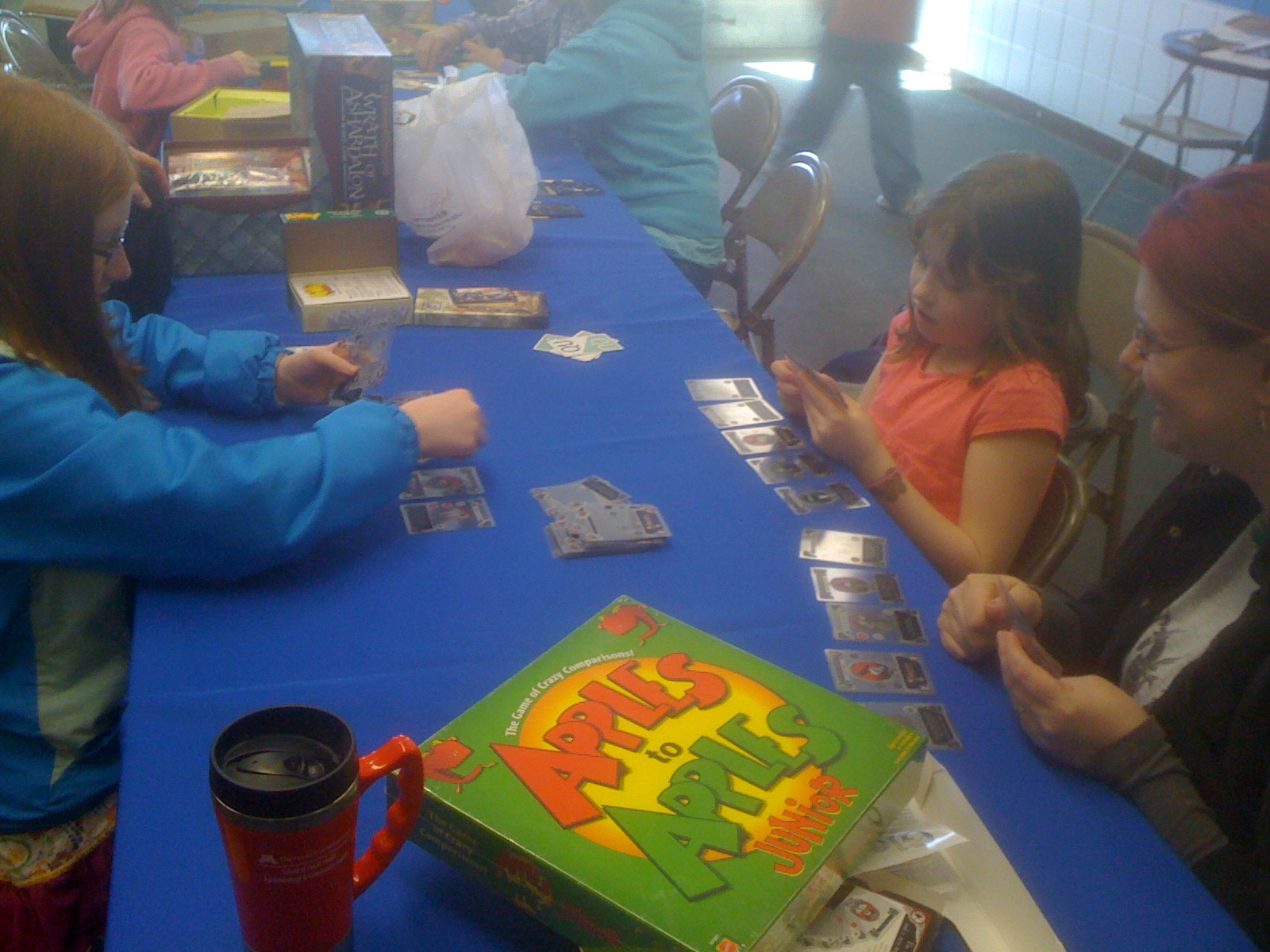
Me playing Gloom with some kids at the Student Council Game Day last May

REVERB GAMERS 2012, #5: Have you ever introduced a child to gaming, or played a game with a young person? How is gaming with kids different than gaming with adults?

The short answer is yes. I used to pack my copy of Kill Doctor Lucky when I went to substitute teaching assignments, and at some schools, kids would come up to me in the hall and ask whether they could sign into my study halls to play whatever I’d brought that day (yes, they asked a sub. Take a moment to absorb that.)

Now I have my own kids, and they’re finally at the ages (9.5 and 5.75, as of this moment) where I can enjoy playing organized games with them. I’ve also been doing this more for other people’s kids over the last year: I helped the Student Council at my boys’ school organize a Game Day, and I taught games at last fall’s Youth Pride Festival in Anoka, MN.

I’m not a particularly patient teacher of game rules, though, and I’m married to Cam Banks, a vastly more experienced GM with the skills and creativity to roll with whatever wacky plans the kids come up with, so I’m usually only in charge of teaching board and card games. That being said, it’s been unexpectedly fun, just over the last few months, to try out new finds and old favorites on my sons. They’ve really arrived at what I consider the earliest optimal age for games. Yes, I know they can play at much earlier ages; you don’t need to convince me. I just have this aversion to one particular feature of gaming with kids (or anyone): the complete devolution into silliness.

I love joking and kidding and having fun at the game table as much as the next person, but both the mom and the Aspergian in me absolutely lose it when kids start making the pawn figures knock each other around the table, and going up chutes and down ladders, and stealing money from the bank, and drawing cards until you get the one you want. Yes, I need to relax, and yes, more play teaches them play etiquette faster. I’ll be the first to say that my reaction is more a matter of me being annoyed than them being annoying. But it’s a barrier to enjoying games, and it leads to the urge to knee-jerk refuse requests to play something.

These things aren’t as much of a problem with RPGs, but sitting down to roleplay with kids requires a level of attention,energy, and uninterrupted time that isn’t always available in the day-to-day chaos. I really enjoy roleplaying with kids sometimes; we had friends’ pre-teen son at our games for several years, and it was just fine.

Gaming with my own pre-teen son is an astonishing experience. He thinks in storyboards, and he’s had an amazing grasp of narrative since he was two (no lie), so his capacity for character-driven drama and decisionmaking is far beyond his years. He’s also got that kid-gift for lateral thinking, which makes him a real Wildcard (see earlier) sometimes.

His Asperger’s brings its own blessings and challenges to the gaming table. His volume control goes away when he’s excited, which is most of the time when he’s having fun. He’s happiest when he’s the center of attention, so he’s not good with extended cut-away scenes that don’t involve his character (Cam does an awesome job of managing game flow to minimize this). And he gets really frustrated when the rules or chance won’t let him do what he’s picturing in his head; he takes it very personally when he can’t bring those visions to fruition. But his attention to detail, steel-trap memory, and typical Aspie fixations mean that, once he’s decided to master a system or if we’re playing in a world he knows and loves, he brings a level of sophistication that is frankly astonishing.

There’s nothing like gaming with kids to blast apart all the stodgy, preconceived notions experienced gamers bring to the table. As with everything else, they’re seeing it for the first time, and their perspective shatters the jaded accretions we’ve picked up over time. It’s good to be reminded of the wonderment we all experienced the first time we discovered the power to build worlds.